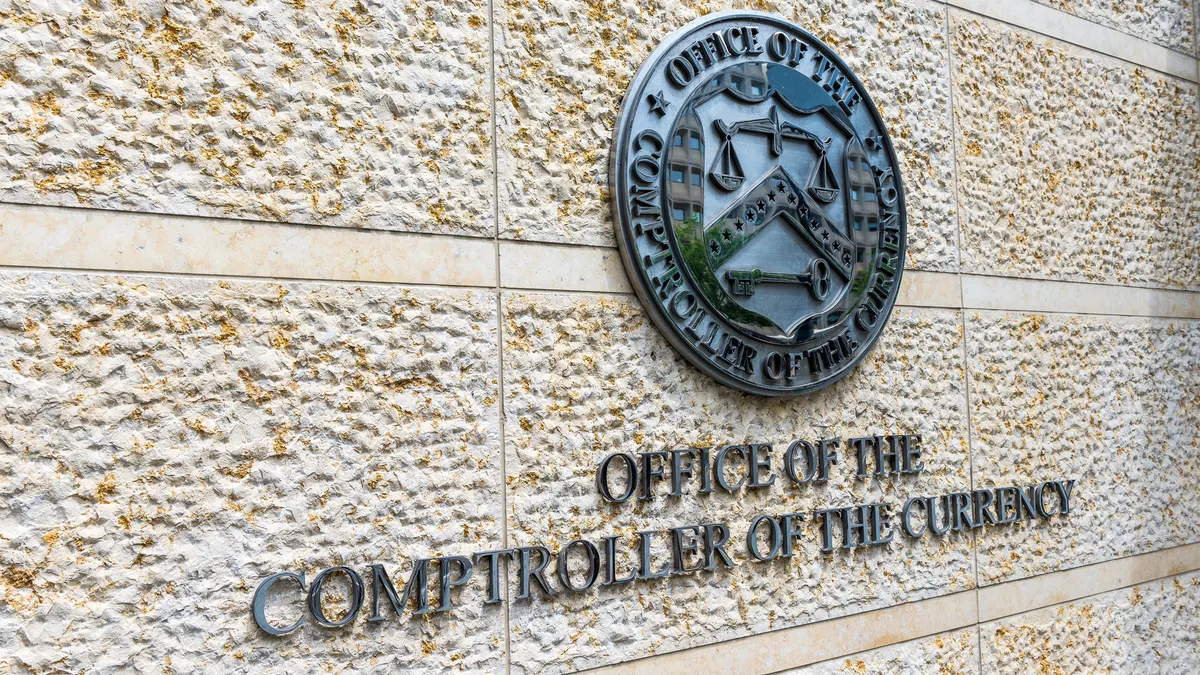
As many charter applications were submitted to the Office of the Comptroller of the Currency last year than in the previous four years combined.
A shift in the tone at the top – by Comptroller of the Currency Jonathan Gould and fellow regulator Federal Deposit Insurance Corp. Chair Travis Hill, who’ve each spoken about the importance of de novo charters – has unleashed pent-up demand.
Much demand has come from the fintech sector. Revolut, for example, has expressed interest in trying for a U.S. charter – though has not yet applied for one – for the “seat at the table” it would afford.
Fintechs have “gained a lot of ground” in market share, product innovation and consumer interest in recent years, said Michele Alt, co-founder of regulatory consultancy Klaros Group.
Initial efforts to welcome fintechs into the regulated banking system in 2016 through a special-purpose national bank charter were unsuccessful. More recently, Biden-era regulators displayed “zero risk tolerance” after the multibillion-dollar collapse of crypto exchange FTX, Alt said.
But in 2025, the White House shift to the Trump administration brought an onslaught of charter applications, including 18 at the OCC alone. Most were for national trust charters, which don’t allow entities to take deposits or lend but permits them to custody assets within the federal framework.
Multiple firms, including Nissan and PayPal, sought industrial loan company charters, which allows FDIC-insured, full-service banks to be owned by nonfinancial firms.
At least one fintech – Checkout.com – sought a merchant acquirer limited purpose bank charter from the Georgia Department of Banking and Finance. Six de novo applicants have since scored conditional charters.
Gould has said the influx is “a return to the norm” for the agency, and that it “signals healthy competition, a commitment to innovation, and should be encouraging to all of us.”
“What we see now is the fintech sector … finally being encouraged and welcomed into the regulatory fold, seeking the benefits of having a banking license and also being willing to meet the very high standards that go along with that privilege,” Alt said.
The result, for 2026? Operations will begin for some or all of the six banks that received conditional de novo charters in 2025. The OCC will decide on 2025’s 12 other applicants, as more charter applications – Alt guesses 25 – are filed.
“We’re just going to see more and more of this” in 2026, Freshfields partner David Sewell told Banking Dive, referring to the boom in charter applications.
The regulatory about-face and resultant charter surge is “the most consequential thing that has happened and probably will happen in my career … without question,” Sewell said.
What’s driving the uptick?
Nonbanks, like fintechs seeking de novo charters and consumer companies seeking ILCs, are attracted to charters for several reasons.
“The main thing is, many [fintechs] work with sponsor bank partners today who play a huge role in bringing their products to market, which provide the pathway for these regulated products to be offered,” said Jasper Sneff Nanni, managing principal at strategic consultancy FS Vector. “Fintechs want more control over how they develop and market their products.”
A charter could also key a nonbank company into a lower cost of funding. Anthony Noto, CEO of SoFi, one of few fintechs that obtained a charter during the Biden administration, said the move allowed the company to lend at more competitive rates and hold onto a greater portion of each transaction without giving a cut to a partner bank.
Additionally, federal charter recipients would only need to answer to a federal regulator – rather than an amalgam of state regulators. That cuts down on, or at least simplifies, compliance burden.
For established banks, the rise of novel charters is “a bit of a wake-up call that a lot of the franchise value of being a bank has been challenged,” Sewell said. Fintechs’ access to charters is “a competitive threat,” he said.
But compared to the roughly 4,000 established banks, the fintech-native banks likely to vie for charters in 2026 are still such a “tiny” part of the market that Alt doesn’t see the competition uprooting incumbents any time soon.
“None of these banks are, out of the gate, going to be going toe-to-toe with the megabanks. But the thing to watch for is how they grow over the next, say, five years,” Alt said.
‘Better mousetrap’
The number of new entrants won’t make a big splash competitively, but the strength of their product offerings might, Alt said.
“Are they better, have they figured out a better mousetrap and are now delivering it with the benefits of a bank charter? Will that turbocharge some of them? Time will tell, but that wouldn’t be this year. That would be, let's talk again in five years and see how they've done,” Alt said.
Bank trade groups have pushed back against national trust charters due to the “risks they pose to consumers and the banking system.”
The ILC charter, meanwhile, has drawn the ire of banks and trade groups for years.
Some lawmakers have argued an ILC designation exempts companies from the definition of a “bank” under the Bank Holding Company Act. As long as industrial banks don’t offer demand deposit accounts, they can fly under the radar of the Federal Reserve, opponents have said.
Recently, Sens. Elizabeth Warren, D-MA, and Andy Kim, D-NJ, proposed a moratorium on commercially owned ILC charters until such entities are defined as “banks” under the BHC Act. However, no such moratorium is in place.
Among the companies that have applied for de novo charters thus far in 2026 are Dutch neobank Bunq and World Liberty Financial, the Trump family’s cryptocurrency platform.
Alt sees no issue with more applicants, and did not make a judgment call on new entrants.
“Occasionally banks fail, occasionally there are problems. It’s the regulators’ job to make sure everything is remediated. If the regulator approves it, they have to supervise it. I’d be surprised if they were blithe about that responsibility,” she said.
Janet Gao, associate professor in finance at Georgetown University’s McDonough School of Business, told Banking Dive she thinks bank charters represent a “middle ground” for fintechs – to hold those firms to higher standards.
“I think the concern is that these financial institutions are not as reliable as banks. These types of fintech firms, they are coming into the light and they're willing to follow and comply with all of these federal banking regulations,” Gao said. “Generally, I think this is an advancement in a good direction.”