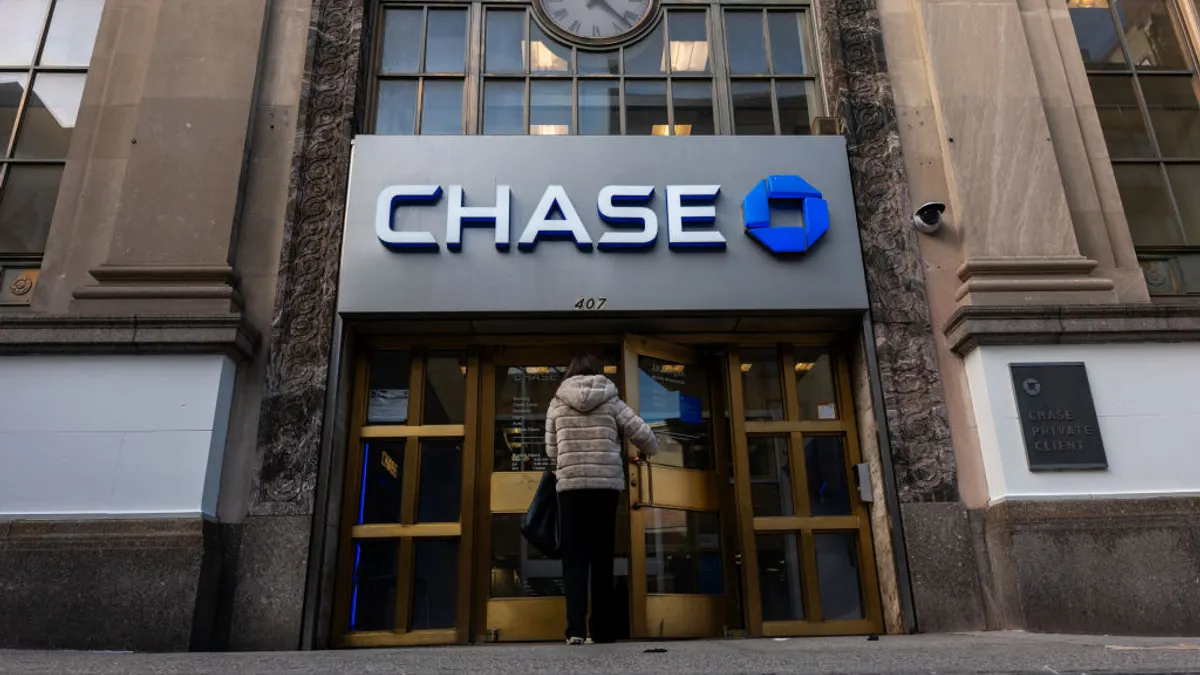
Investors of crypto firm Goliath Ventures sued JPMorgan Chase last week for allegedly ignoring what they call “red flags” that enabled a $328 million “Ponzi scheme” that’s under federal investigation.
Between January 2023 and June 2025, Chase acted as Goliath’s sole bank as the crypto firm solicited people, under false and fraudulent pretenses, to invest money in exchange for returns generated through crypto “liquidity pools,” the investors alleged. Goliath promised investors 3% to 8% in monthly returns.
But Goliath CEO Christopher Alexander Delgado was not running a legitimate business, the Justice Department said. Rather, he’s been charged with money laundering and wire fraud.
Delgado was arrested last month.
“Numerous red flags made the fraudulent nature of the scheme obvious and known to Chase,” wrote Robby Alan Steele, plaintiff in a proposed class action filed last Wednesday in the U.S. District Court for the Northern District of California. “Despite those red flags, Chase turned a blind eye and continued servicing the accounts used to perpetrate the fraud, earning substantial fees from the hundreds of millions of dollars it washed through Goliath and Delgado’s banking activities at Chase.”
Steele liquidated his retirement account to invest in Goliath, but saw the money vanish after he wired it to Goliath’s Chase bank account. More than 2,000 individuals invested at least $328 million in Goliath.
A spokesperson for JPMorgan Chase didn’t immediately respond to a request for comment.
CEO Jamie Dimon was once a cryptocurrency critic, the lawsuit noted. He called crypto tokens “pet rocks” in 2023. Nonetheless, the bank partnered with cryptocurrency exchange Coinbase in 2025.
“Now, not only was Chase open to the public purchase of cryptocurrency ‘pet rocks,’ it was actively encouraging, enabling, and profiting from those purchases — so much so that it turned a blind eye to, and in fact aided and abetted, a $328 million dollar cryptocurrency Ponzi scheme,” the lawsuit alleged.
The lawsuit does not name Coinbase as a defendant. But of the money deposited into Goliath’s Chase account between January 2023 and June 2025, roughly $123 million was transferred to Coinbase, and $50 million was sent to investors as purported returns, the lawsuit alleged.
“With respect to the criminal matter referenced in the lawsuit, which also does not target Coinbase, we fully met our compliance obligations and remain steadfast in our partnership with banks and law enforcement to ensure bad actors are held accountable and the ecosystem remains secure,” a Coinbase spokesperson said in an emailed statement.
The suit also mentions Dimon’s public criticism of cryptocurrencies, adding that it contradicts the bank’s alleged conduct.
“Despite Dimon’s long history of criticizing cryptocurrency,” the complaint said, Chase “knowingly permitted a bank customer — Goliath — to commingle investors’ money at Chase” and use funds from later investors to pay earlier ones “in a classic Ponzi scheme fashion."
Chase continued its relationship with Goliath after developing “actual knowledge” of its Ponzi scheme, Steele alleged.
“From a bank’s perspective, the fraudulent scheme was obvious,” the lawsuit alleged. “A fraudulent scheme of this magnitude cannot be run surreptitiously through one bank. And here, it did not.”