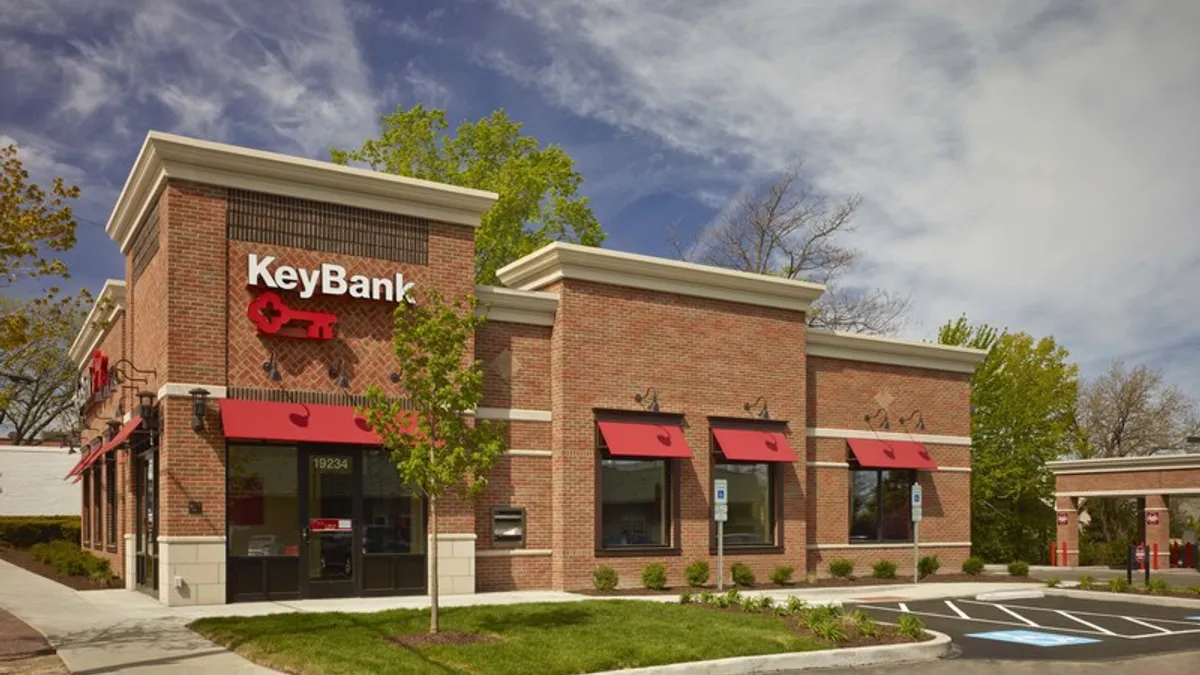
Cleveland-based KeyBank tends to be a “fast follower” in the digital space, said Emily Gessner, the regional lender’s head of consumer digital.
With some of its experiences, “we are benefiting from seeing how banks have done it and refining it and trying to do something different,” she said in a recent interview.
That includes positioning a forthcoming personalized insights feature front-and-center in the bank’s mobile app, and deploying a mobile app-only strategy to better serve the $189 billion-asset bank’s younger customers, Gessner said.
Still, “regional banks are at a very critical inflection point, and with competition being as high as it is, I do think we owe it to our clients to start to take more progressive, larger steps forward to satisfy their client needs and their expectations, because those are evolving so quickly,” she said.
The bank has to have continuous improvement baked into each of its capabilities over time, Gessner said.

“Throwing a tablestakes capability out there, and then just letting it run, so to speak, is no longer reasonable, nor is it acceptable from a client perspective,” she said.
“That’s a real opportunity for regionals broadly,” Gessner added.
Next month, she’ll become head of commercial digital after occupying the consumer digital role for three years. She intends to bring the consumer mentality with her, as the commercial space increasingly demands consumer banking and payments capabilities.
Digital banking is fiercely competitive and transactional, and Key is positioned in the middle of the competitive landscape, Gessner said.
“It can be a sweet spot or a sore spot, depending upon the topic of the day,” she said.
Technology, for example, can be the latter, since the 201-year-old regional lender competes with big banks and their much larger tech budgets, and fintechs starting fresh from a data and infrastructure perspective.
But Gessner views the bank’s history as an opportunity, as it endeavors to layer smooth and intuitive digital experiences on top of long-standing relationships cultivated over time.
“I’m not sure I’d want to necessarily be on the other side of that, where you have the great tools but you’re trying to gain loyalty in a very commoditized, transactional type of space,” she said. “The advantage regional banks still have is that trust and human advantage.”
Regional squeeze
Many regional banks, particularly those with between $30 billion and $100 billion in assets, are being squeezed by rapid industry change tied to artificial intelligence, legacy tech modernization and the competitive threat from fintechs, said Brett Mastalli, the banking lead at consulting firm West Monroe.
In the modernization push, many regionals feel the “need to get more aggressive in what [they] want to do with [artificial intelligence],” he said.
Regionals “don't have to be cutting-edge on their technology,” Mastalli said. “They need to be competitive, and they need to think about how they want to manage and provide support to that customer relationship.”
For Key, the consumer bank makes up about 32% of loans and 60% of deposits, according to a recent investor presentation. The lender, which operates in 15 states and has about 950 branches, has grown consumer deposits by about $14 billion over the past seven years.
In the consumer digital space, Key has focused on modernizing originations experiences and enabling more do-it-yourself servicing interactions, Gessner said.
In three years, the bank has gone from about eight origination platforms to four and replaced legacy front- and back-end technology. The bank has shaved about 15 minutes from the consumer account opening process and about 30 minutes from the small and medium-size business deposit application time, she said.
In servicing, Key has built out mobile app capabilities that allow customers to start and finish their task within the same session, and nudge them to take certain actions, Gessner said.
“We’ve made major progress there around disputes, adding co-owners, adding beneficiaries,” she said.
In April, the bank rolled out enriched transactions, providing customers with more detail, through a partnership with Personetics, which it struck in March 2025.
Transaction inquiries are the bank’s No. 1 call center driver, Gessner said, so the enriched transactions feature gives customers the information they’re seeking while reducing the bank’s call load. Plus, the transaction detail can be pumped into AI-powered models that allow Key to serve up personalized insights and prompt customers on budget opportunities or spending trends.
AI assistant ‘the next step’
Piloting of personalized insights is underway now, and the bank aims to roll out that function during the third quarter. That will help Key “bring that personalized, relationship-feeling experience into our mobile app, where it’s very transactional today,” she said.
Those insights come in the style of push notifications, but there may be a benefit to positioning them in a more advisory way through conversational AI, she said.
Key has chatbots within its mobile and online banking platforms, but a conversational AI-powered assistant is “the next step for us,” Gessner said.
Similarly, an AI assistant could help in a servicing capacity, prompting a customer on next steps if a certificate of deposit is coming due, she said. And on the commercial side, there's an opportunity to automate service requests.
Gessner declined to identify when the bank might launch an AI-powered assistant, but noted 2027 technology funding conversations are underway.