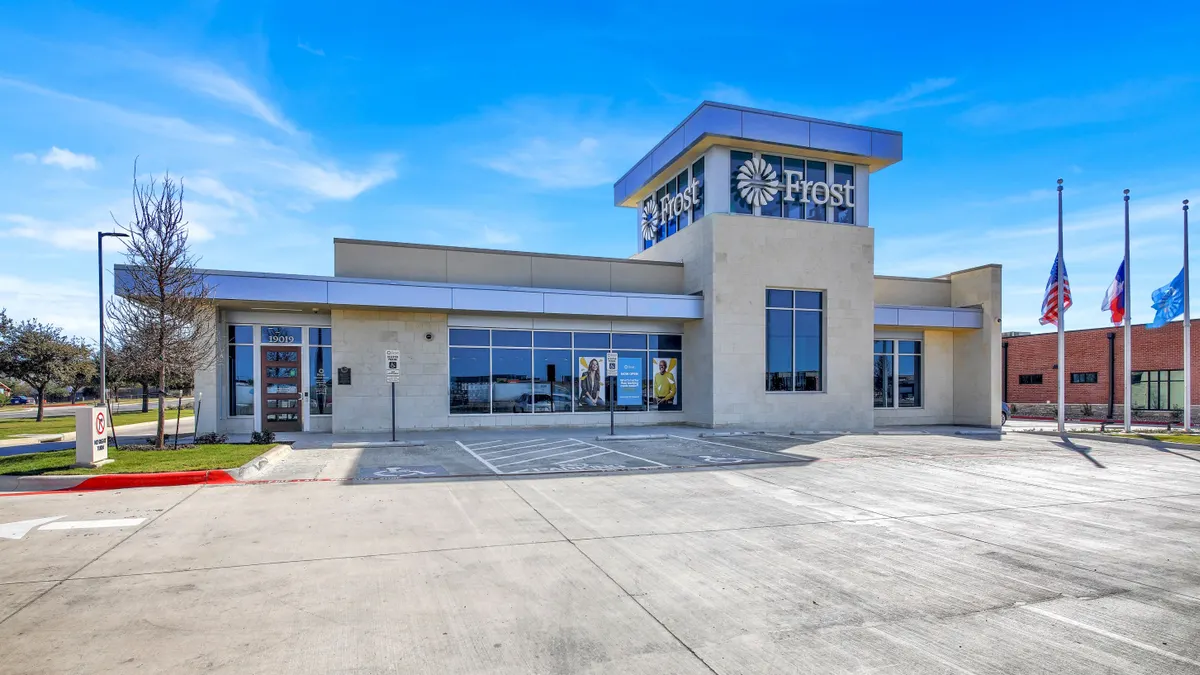
Frost Bank’s CEO expects intense banking competition in Texas may cool slightly after some lenders making “structure-light” loans learn over time whether their decisions were right.
CEO Phil Green told analysts during the bank’s second-quarter earnings call Thursday that Frost is seeing heightened lending competition, and when the bank loses deals, it’s mainly commercial real estate loans and related to loan structure.
To Green, it seems like “a bit of a race to the bottom on some of these structures,” he said. “We see people who are very aggressive in the market, and then things turn a little bit and they disappear.”
A day earlier, executives at Texas peer Prosperity Bank said competition in the state, particularly from larger banks, was making it tough to grow loans profitably. Many top-10 banks as well as regionals such as Fifth Third, Huntington and Regions are chasing business in Texas as the state’s population and business presence has expanded.
“We're not going to put a bunch of stuff on the books,” Prosperity CEO David Zalman said Wednesday, “just to grow loans and not be profitable and take the risk.”
While $54 billion-asset Frost seeks to remain competitive on price, the structure element of loans can be tough, because it’s “dangerous to do that poorly,” Green said in an interview.
If economic conditions sour as loans mature, “you could end up working through some problems that you didn’t want to,” Green said. “If they're not quite what you thought they were, you're going to figure it out in a couple of years.”
He pointed to lenders not requiring a guarantee on a loan as an example.
Green said the San Antonio-based bank’s low funding costs allow it to be flexible with pricing, and Frost’s lending approach is based on relationships.
“We’re not looking to just get volume by having low price,” he said. “We’re really applying this to relationships that are really strong and prospects that are potential relationships that are really strong. We’re trying to use it with discretion and use it for business that makes sense for us.”
Frost’s average loans for the second quarter grew about 7% year over year and 3% from the prior quarter, to $22.6 billion, according to an earnings release.
Still, there are limits, and the bank still has a business to run.
“Some of that's just common sense and your feel for what you should get paid for a particular business or risk,” Green said. “What is it about obscenity the Supreme Court said? ‘You know it when you see it.’ And some of the pricing can be pretty obscene.”
Amid a competitive deposit environment, Frost saw increased volumes of interest-bearing deposits and a higher overall cost of deposits in the second quarter, as CFO Dan Geddes indicated the bank has seen some yield-seeking behavior.
The bank is seeing highly competitive rates for certificates of deposit or money market accounts, and some with “urgency,” where the rate will disappear if action isn’t taken by a certain time period, which Frost doesn’t do, Geddes said Thursday.