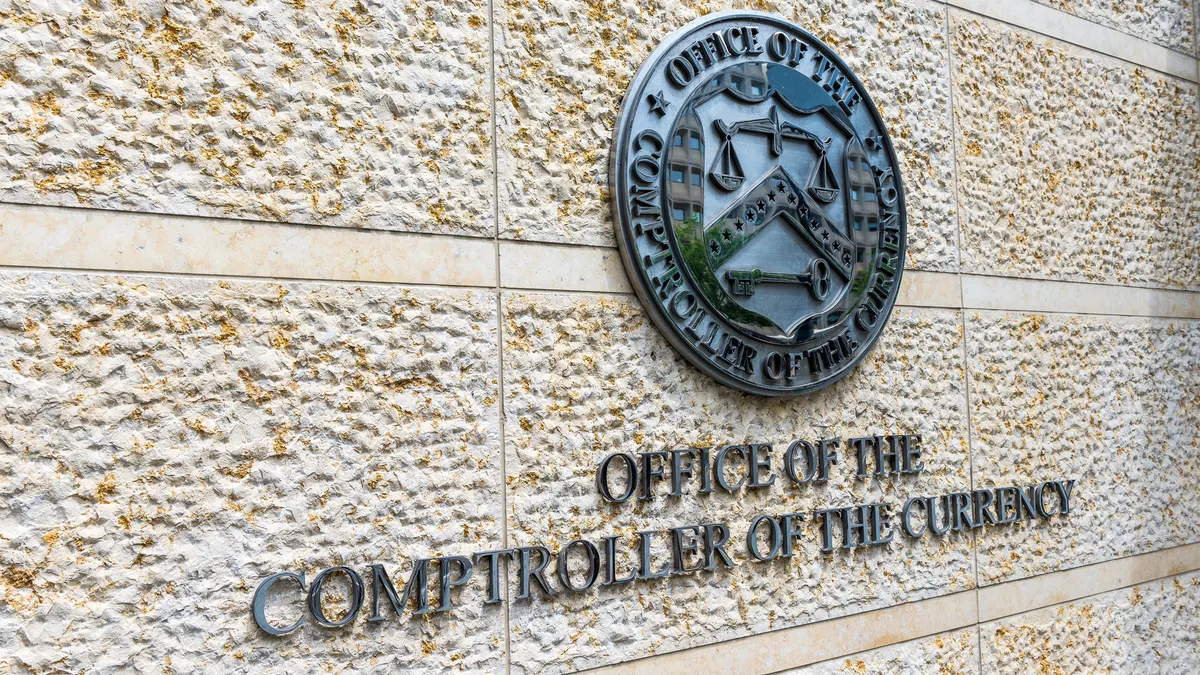
Nine banks supervised by the Office of the Comptroller of the Currency “made inappropriate distinctions among customers” because they kept policies that restricted banking services to clients with ties to certain industries, the agency said in a preliminary report Wednesday.
The report stopped short of detailing specific instances when particular banks held named customers at arm’s length over specific policies. It did, however, cite the banks’ environmental, social and governance policies or corporate responsibility and policy statements from 2020 to 2022 as source material.
The banks are JPMorgan Chase, Bank of America, Citi, Wells Fargo, U.S. Bank, PNC, Capital One, TD and BMO.
The OCC expressed concern that, between 2020 and 2025, the banks restricted access or required “escalated reviews and approvals before providing … access” to certain customers with connections to oil and gas, coal, firearms, private prisons, tobacco, payday lending, adult entertainment, digital assets or political action committees and political parties.
It’s that last part that, presumably, spurred President Donald Trump in January to accuse Bank of America – while its CEO was on stage at the World Economic Forum in Davos, Switzerland – of debanking conservatives.
“You’ve done a fantastic job, but I hope you start opening your bank to conservatives … because what you’re doing is wrong,” Trump said at the time.
“We never close accounts for political reasons and don’t have a political litmus test,” a spokesperson for the bank said in January.
A month later, Moynihan doubled down. “We bank everybody,” he said. “But the real question was about over-regulation, frankly.”
Since that blow-up, many major U.S. banks have retooled their policy statements to de-emphasize language on ESG and diversity, equity and inclusion.
Citi went a step further in June, abandoning a 7-year-old policy restricting firearms sales by its retail clients.
The OCC warned banks in September it would review “on a case by case basis,” lenders’ records of and policies and procedures “designed to avoid engaging in politicized or unlawful debanking.”
The agency added it would take “politicized” debanking into consideration when it reviews licensing filings and Community Reinvestment Act ratings.
“It is unfortunate that the nation’s largest banks thought these harmful debanking policies were an appropriate use of their government-granted charter and market power,” Comptroller of the Currency Jonathan Gould said in a statement Wednesday. “While many of these policies were undertaken in plain sight and even announced publicly, certain banks have continued to insist that they did not engage in debanking. Going forward, the OCC will hold banks accountable for these actions and ensure unlawful debanking does not continue.”
The OCC is “still reviewing thousands of complaints to identify instances of political and religious debanking, which it will report on in due course and as appropriate,” the agency said Wednesday.
The report, however, lends credence to disclosures JPMorgan and Bank of America made last month.
BofA told the Securities and Exchange Commission it is “responding to demands and requests regarding ‘fair access to banking,’ including those resulting from” an executive order Trump issued in August, “which directed government agencies to review financial institutions’ policies and practices for providing, maintaining, or discontinuing financial products or services to certain clients or potential clients.”
In a blog post Thursday, Adam Levitin, a Georgetown University professor of law and finance, called the OCC report a “nothing burger,” adding the banks’ actions were “100% legal.”
“The OCC did not find any evidence of denial of services, just of heightened review for certain lines of business that pose reputational risk,” Levitin wrote. “There is no such thing as ‘unlawful debanking activities’ except debanking someone based on race (which would violate the Civil Rights Act of 1866).”
The Bank Policy Institute, a trade group representing banks, said Wednesday the industry “supports fair access to banking and is already working together with Congress and the administration to ensure banks are able to serve law-abiding customers.”
“It’s in banks’ best interest to take deposits, lend to and support as many consumers and businesses as possible to drive economic growth,” the BPI said, adding that it supports “recent regulatory efforts and clear and consistent standards that protect access to America’s banking system while maintaining sound risk management.”
Banks, during Trump’s first term, publicly distanced themselves from clients with ties to certain industries. Barclays, SunTrust (now Truist) and others agreed to stop financing private prison operators in 2019. Citi and Bank of America adopted more cautious policies toward financing firearms manufacturers and distributors in the wake of the 2018 Parkland, Florida, school shooting.
BofA, however, tweaked the language of its environmental and social risk policy in 2023, loosening restrictions pertaining to the firearms and energy sectors.
“Banking decisions should be based on individualized, objective and risk-based analyses, not politics or ideology,” the OCC said Wednesday.