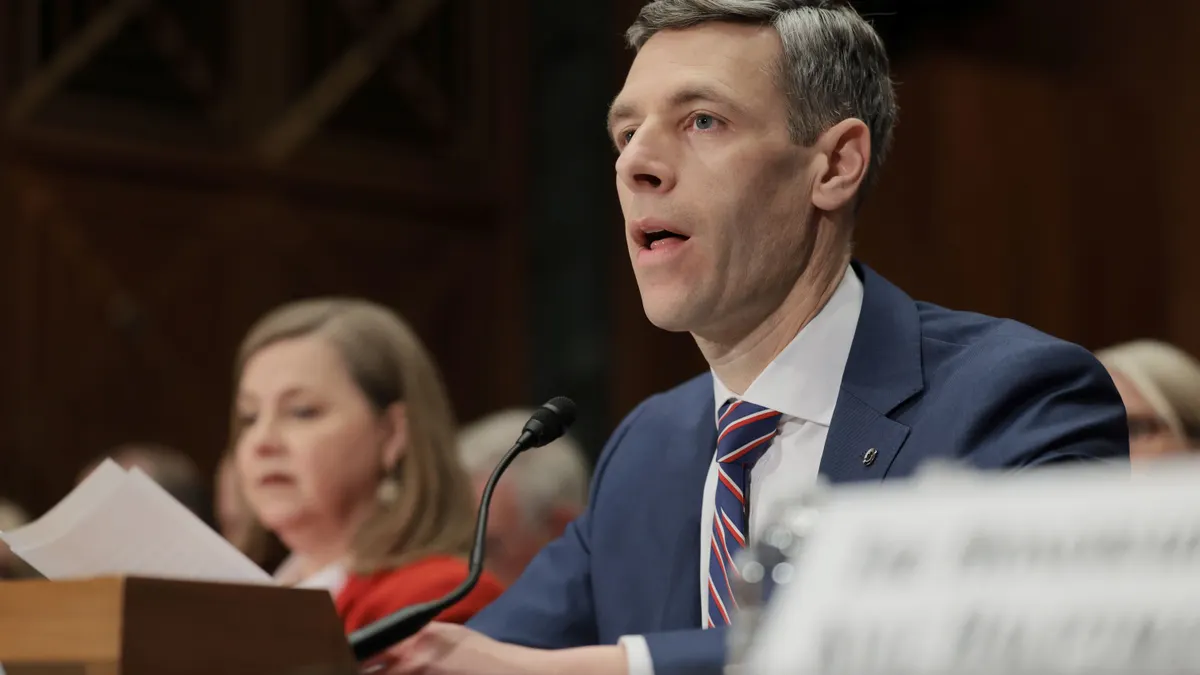
The Office of the Comptroller of the Currency on Wednesday followed through on its promise to show proof that nine banks under its purview held “policies or practices” between 2020 and 2025 that “may have required, encouraged or otherwise influenced” debanking on the basis of customers’ political or religious leanings.
The regulator last December called out JPMorgan Chase, Bank of America, Citi, Wells Fargo, U.S. Bank, PNC, Capital One, TD and BMO in a preliminary report on debanking.
Wednesday’s 47-page follow-up “provides irrefutable evidence that the nation’s largest banks have denied, debanked and discriminated against customers and lawful businesses,” Comptroller of the Currency Jonathan Gould said in a statement. “Americans should have access to financial services regardless of their beliefs, affiliations or political views. Fair access to financial services is not a mantra – it is a mandate.”
Several of the banks named in the report – JPMorgan, Bank of America, U.S. Bank and Capital One, in particular – told investors over the past year that they were “responding” to requests from federal agencies regarding discontinuation of financial services against certain customers.
JPMorgan Chase on Wednesday said its policies prohibit discrimination based on political or religious views. The OCC’s report cites “a limited number of historical interactions,” the bank asserted, adding it has “improved the way we do business.”
“We agree with the administration on a broader point: years of operating in a regulatory environment that often second-guessed decisions contributed to a culture of caution across the banking industry,” JPMorgan said in a statement to Bloomberg. “That system needs fixing.”
Gould emphasized Wednesday that the report was not the end of discussion on the matter.
"Notwithstanding certain efforts by the largest banks to rein in these practices, I am not confident that they will be enough," Gould said. "The OCC will be assessing further changes to the regulatory and supervisory framework … to reduce the likelihood of these harmful practices recurring in the future.”
The OCC wasn’t the only regulator to pile on. The Consumer Financial Protection Bureau on Wednesday said it will “fully investigate whether the institutions featured in OCC’s report and others have complied with federal consumer financial laws and take appropriate action.”
“It is appalling that these banks targeted American consumers for their political, social, or religious beliefs that did not align with the Biden Administration or its leftist allies,” CFPB Acting Director Mark Paoletta said in a statement. “These thuggish tactics, which were also a defining feature of the Biden-Chopra CFPB, have no place in America.”
The CFPB said it is reviewing consumer complaints, and supervisory and enforcement data, for evidence of wrongful debanking, and is investigating based on those data points.
For its report, the OCC said it reviewed nearly 100,000 complaints to institutions it regulates, and combed roughly 420,000 pages of documents on bank policies, procedures, practices and individual customer decisions.
The agency said “broad” reputational risk policies “lacked clear standards and objective, risk-based criteria,” which “disadvantaged certain Americans.”
Banks maintained public and nonpublic policies restricting certain industries’ access to financial services, the OCC said, citing examples.
JPMorgan, for instance, repeatedly denied services to a conservative-leaning retailer from 2021 to 2023, the agency argued Wednesday.
“As more far-right competitor [companies] step in to take this company’s extreme clients, it may become more mainstream and more appropriate for JPM to bank,” the report quoted bank documents as saying.
TD, the OCC said, denied a COVID-era emergency loan to a nonprofit that took an anti-immigration stance. The OCC asserted the loan denial was influenced by the nonprofit’s status as a “hate group,” according to the Southern Poverty Law Center.
Not every debanking instance in the report went against conservatives. The OCC alleged that Capital One rejected an organization that supported reproductive rights including abortion access. The agency cited, among its documentation, the assessment of a risk employee at the bank who said the organization’s “[c]ontributions to politicians are about 95% Democrat.”
Debanking has been a hot-button issue for President Donald Trump since he returned to the White House. During the first week of his second term, he publicly accused Bank of America and JPMorgan of unfairly denying services to conservatives. Trump has since sued both JPMorgan and Capital One on similar grounds.