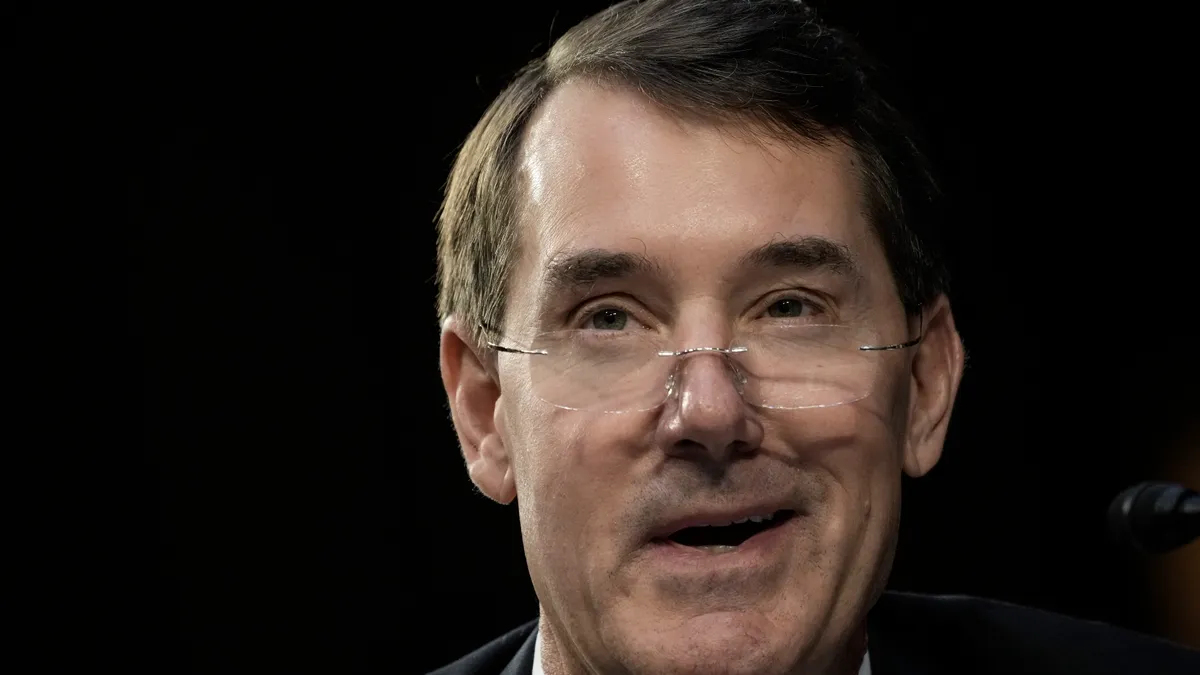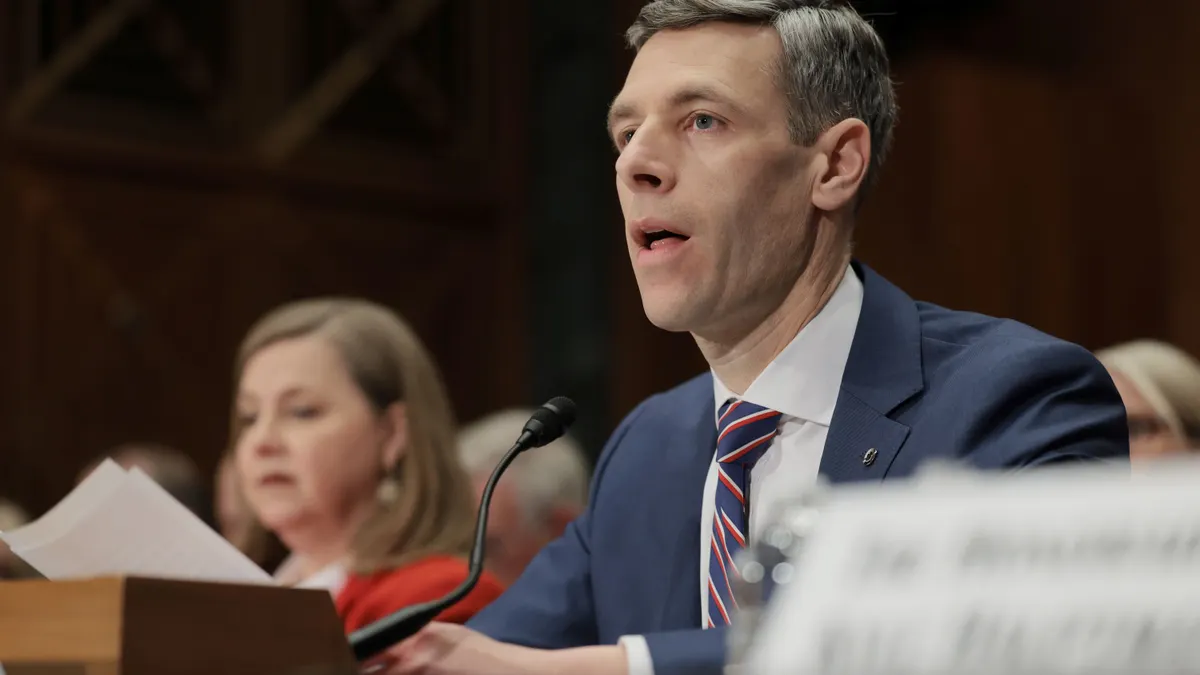
Comptroller of the Currency Jonathan Gould pledged Wednesday to “double down” on three areas of focus: tailoring supervision to emphasize material financial risk, ensuring the regulatory burden doesn’t hinder economic growth, and embracing innovation.
That innovation takes many forms, from artificial intelligence and stablecoins to lifting the barrier of entry so new charter applicants can refresh the banking system, Gould said in remarks Wednesday to the Exchequer Club of Washington, D.C.
Here are six highlights from his comments.
1. Charters
The Office of the Comptroller of the Currency has approved 28 charter applications in the past two years, “with several dozen more in the pipeline,” Gould said.
Put another way, the agency received as many charter applications in 2025 as it did in the previous four years, the OCC chief noted.
“A functional chartering process allows the banking system to renew itself and remain dynamic,” Gould said. “It brings new capital and new ideas into institutions subject to federal supervision. That is especially important as technology changes how Americans expect to receive financial services.”
2. AI
Just as banks are not required to distinguish AI as its own risk category, the OCC won’t treat banks’ embrace of AI separately as it relates to evaluating risk, Gould said.
Rather, AI is “a component of preexisting business operations and practices,” and the OCC intends to maintain a “right-size approach to innovation,” Gould said.
“Supervisory judgment should reflect what new technology does and the potential consequences of its use,” he said. “As that technology evolves, the OCC’s workforce and approach will evolve with it.”
3. Community bank competitiveness
Gould pledged “appropriately focused supervision” for community banks.
“Sound supervision and a healthy banking system are not objectives that can be achieved by subjecting all banks to the same standards,” Gould said.
Gould cited the OCC’s 2025 “Community Bank Comeback” initiative, which he credited with tailoring bank exams to risk and dedicating a group of examiners to banks with less than $30 billion in assets.
“A lasting Community Bank Comeback also requires new entrants,” Gould said, noting that nearly half of community banks have closed since the 2007-08 financial crisis, yet new entrants to the banking system have not replaced them.
“This is the ideal formula for the mega banks to grow larger and the system to become less dynamic,” Gould said. “We have made clear that the OCC is now open for business.”
4. Stablecoins
Gould emphasized that community banks have an “important place” in the stablecoin ecosystem.
“The opportunities created by financial innovation should be within reach of Main Street banks,” he said.
5. Debanking
Gould took occasion Wednesday to note the OCC’s analysis last month that found nine banks under its purview held “policies or practices” between 2020 and 2025 that “may have required, encouraged or otherwise influenced” debanking on the basis of customers’ political or religious leanings.
“Banks are not a proper vehicle for achieving social or policy objectives outside of the legislative process, and we will help banks resist the temptation to use their privileged positions as financial intermediaries to indulge their inner activists or external interest groups,” he said Wednesday.
6. Risk
Gould also noted that the OCC, during his stint at the helm, has put more rules into effect – “in one-third the time frame” – than the agency did under its immediate previous leadership.
But Gould wants to ensure that new rules are “fit for purpose,” he said.
“Regulators’ short-sighted attempts to eliminate risk from the industry forced a significant amount of lending and investment activity outside of the regulated banking system,” Gould said, adding that the burden of complying with those rules left some community banks out of the loop.
“Too big to fail actually created too small to succeed,” he said.
Gould cited the agency’s work alongside the Federal Deposit Insurance Corp. to finalize a uniform definition of unsafe or unsound practices and create clearer standards for the supervisory category of “matters requiring attention.”
“Banks should understand the basis for a supervisory criticism and what is required to resolve it,” Gould said. “Transparency via regulation is furthered by bolstering examiner judgment through eliminating checklists and refocusing on material financial risk.”