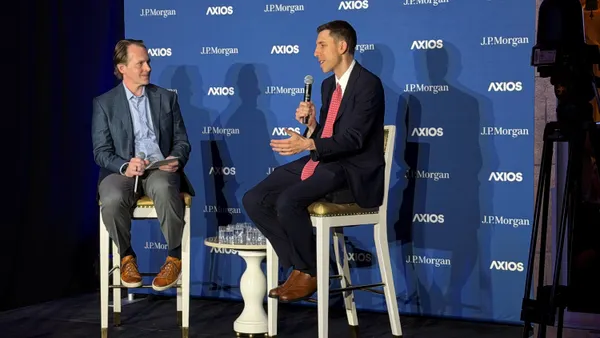
With Flushing Financial being OceanFirst’s eighth whole-bank acquisition, the Red Bank, New Jersey-based lender has built a system in recent years geared toward retaining the acquired company’s customers and employees, said OceanFirst CEO Chris Maher.
“Probably the most important thing we do is immediately provide assurance to the folks that are in front of the customer, that they will have not just jobs but career opportunities at OceanFirst as we grow,” said Maher, who’s been CEO of the bank since 2015.
“We get that message out early, because the most important thing for our clients is typically, they want to know that their banker is going to stay at the bank,” he said.
There will be some role consolidation, primarily in administrative, operational and other non-customer facing jobs, the bank said, but didn't immediately detail how many roles will be eliminated.
The $579 million acquisition of Long Island-based Flushing Financial – which closed Monday – is OceanFirst’s largest purchase yet. Absorbing Flushing’s $9 billion in assets and 30 branches is designed to accelerate the larger lender’s growth in three New York City boroughs and Long Island.

OceanFirst has about 40 branches across New Jersey and in major metro areas from Massachusetts to Virginia. Since OceanFirst entered New York in 2019, the bank has built a $2 billion-asset business in the state, Maher said.
OceanFirst, which now has about $23 billion in assets, isn’t planning any branch closures, Maher said, adding that Flushing’s 30-branch footprint is efficient and ideally situated. He expects to be operating under a single, unified brand by the beginning of the fourth quarter.
“Beginning on Oct. 1, there’ll be a very significant commitment of marketing dollars to introduce the OceanFirst brand into communities that may not have known us as well,” he said. The bank declined to share a projection related to that expense.
“That’s critical that we execute that well and that we establish our presence in a pretty crowded banking market,” he said.
“From a customer perspective, if the branches remain the same, staff remains the same, and you do a careful and low-impact integration, you're going to have a very successful outcome,” he said. “It's not unusual in past acquisitions for us to retain north of 96%, 97% of those customers, and I’m hopeful we'll be able to do the same thing here.”
Another key element to customer retention, according to Maher: OceanFirst is donating $5 million of the bank’s stock to the OceanFirst Foundation, which will support nonprofits operating within Flushing’s footprint.
That model has “been critical” for OceanFirst with past acquisitions, he said, because it demonstrates a commitment to the communities the acquiring bank now serves.
Private equity firm Warburg Pincus also had a role in the Flushing deal, investing $225 million toward a capital raise that gives it a 12% stake in OceanFirst and a board seat.
The acquisition is one strategy to improve OceanFirst’s financial performance, Maher noted. The bank seeks to bolster earnings per share and push returns on assets above 1% over the next several quarters, and “the acquisition will help us do that to some extent,” he said.
OceanFirst’s first-quarter profit was flat year over year, at $20.5 million, but increased from $13.1 million in the prior quarter, according to an earnings press release. The bank also reduced its non-interest expenses by 13%, to $73.4 million.
To add to that effort, OceanFirst is hiring bankers. Maher declined to share a projection of new hires this year, although he said the bank tends to bring on a couple dozen annually and is on pace to be in that range this year.
OceanFirst expects to see the fastest growth in the next year or two within its relationship-driven commercial and industrial banking business, as the lender has added talent that brings along customers.
Buying Flushing also boosts OceanFirst’s commercial real estate concentration ratio to 461%, from 417%. Regulators more closely scrutinize banks whose CRE loans account for more than 300% of risk-based capital, and OceanFirst has said it intends to reduce that figure in coming quarters.
“We’re thinking hard about the balance sheet,” Maher said, and “looking at ways we can de-risk that and bring down exposure to commercial real estate.”
“Unlike other acquisitions, we may do some balance sheet restructuring in connection with this closing, so that we can present the business with more balanced risk characteristics,” he said.
OceanFirst is entirely focused on Flushing for now, but Maher didn’t shut down the possibility of another acquisition.
“We're mindful that the industry continues to go through a consolidation,” he said. “We might consider other opportunities, but only after we deliver the value that we expect to deliver in this transaction.”
Pointing to regulatory transparency around M&A and faster deal timelines reducing risk, Maher said “it’s a very favorable environment to think about M&A.”
The CEO also said he’s pleased to see federal banking agencies clarify regulatory intent and address “the use of judgment in the way that certain determinations are made, the way the appeal process should be handled, the way that ratings should be assigned, the importance of material financial issues,” he said.
One issue that has plagued OceanFirst in recent years is its Community Reinvestment Act rating. The figure dropped in 2022, and the bank agreed two years later to pay more than $15 million to resolve redlining allegations. Months later, the bank received an “outstanding” CRA rating.
“We like level playing fields, we like transparent rules, we like objective evaluations,” Maher said.