



Banking giants that spent years investing in AI are starting to see the technology’s effects on business operations — and their workforces.
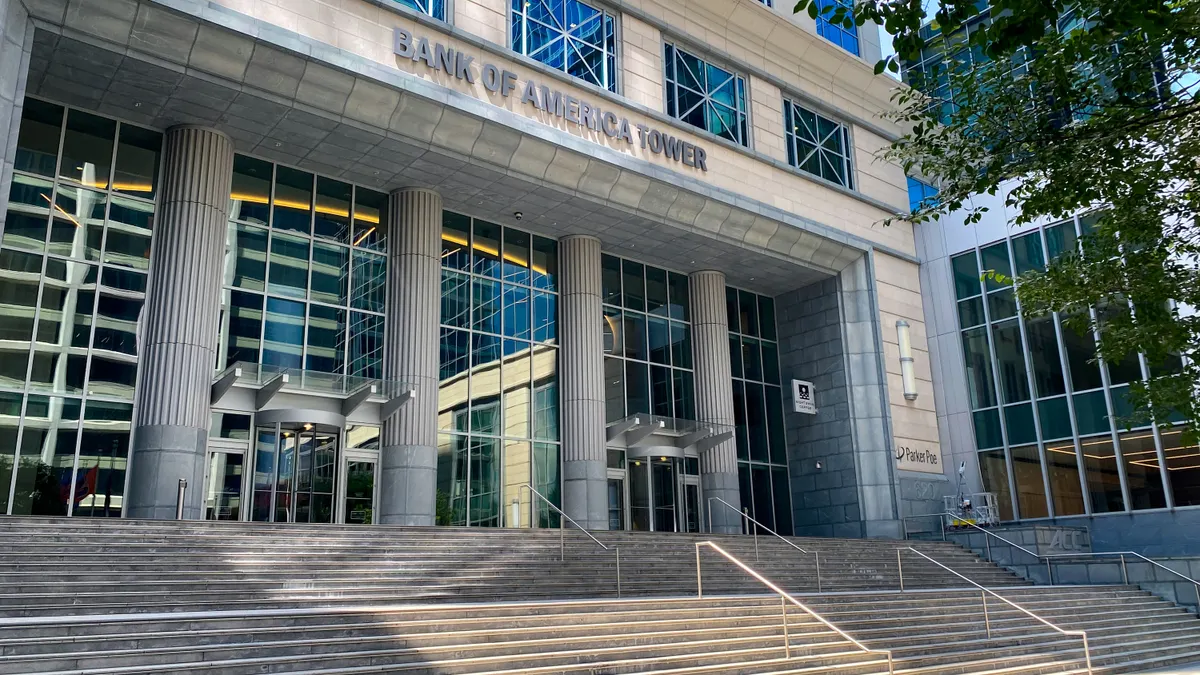
Over 200,000 Bank of America employees use AI-enabled capabilities, CEO Brian Moynihan told investors during the bank’s Q2 2026 earnings call July 14. Employees are using AI-based productivity tools, coding support tools and advanced agentic workflows, generating more than 400,000 prompts daily, he said.
As of last week, the banking giant had more than 300 approved AI use cases, including 114 generative AI use cases. Moynihan said 34 of the approved AI use cases are fully implemented within the bank’s operations.
“These tools are designed to help our customer relationship managers prepare more thoroughly for the client meetings,” Moynihan told investors during the call. “Our developers code more efficiently and all our teammates improve productivity, consistency and client service while creating significant opportunities ahead of us.”
Bank of America CFO Alastair Borthwick said the business has benefited from strong financial adviser productivity driven largely by AI. Earlier this year, the bank’s wealth management team rolled out an AI-powered tool for its financial advisers to better access its Salesforce CRM data.
“AI-enabled tools are now more embedded in workflows across operations, risk, finance, technology, and our client-facing teams,” Borthwick said during the earnings call. “That’s helped reduce manual work, improve speed and enhance consistency for clients and teammates.”
AI powers operations, productivity
Bank of America isn’t the only firm reporting operational changes and employee engagement with AI tools. Wells Fargo last week launched AI Teammate, with CEO Charlie Scharf noting that the company’s AI investments are helping boost productivity.
Meanwhile, at Citigroup, CEO Jane Fraser said as the firm’s transformation work nears its end, business leaders have been able to apply their learnings about large-scale technology implementations to integrate AI into the bank’s business processes and functions. Citi brought on Brian Saluzzo as CIO in March to help further scale AI across the organization.
“Nearly 9 out of 10 of our people are using our AI tools,” Fraser told investors during the bank’s Q2 earnings call July 14. “That’s not only driving productivity and client experience but also growth, helping us bring products to market significantly faster.”
At BNY, CEO Robin Vince said AI is creating value by increasing employee productivity, helping the bank build better products and client experiences and bringing new capabilities to market through the bank’s platforms and data.
AI is becoming a significant source of long-term value creation for the bank’s clients, employees and shareholders, Vince said during the bank’s Q2 earnings call Wednesday.
JPMorgan Chase CEO Jamie Dimon offered a slightly different take on the benefits of AI when talking to investors July 14.
The firm has nearly 1,000 live AI use cases across risk, fraud, marketing document reading and other areas, Dimon said during the Q2 earnings call. However, while he expects the technology will lead to efficiency within certain parts of the company, Dimon said the biggest winners will be customers.
Dimon said AI is expensive and he doesn’t expect to see it increase company margins anytime soon as usage scales.
“You don’t uniquely benefit from AI,” Dimon said. “The ultimate beneficiary of AI will be our customers.”