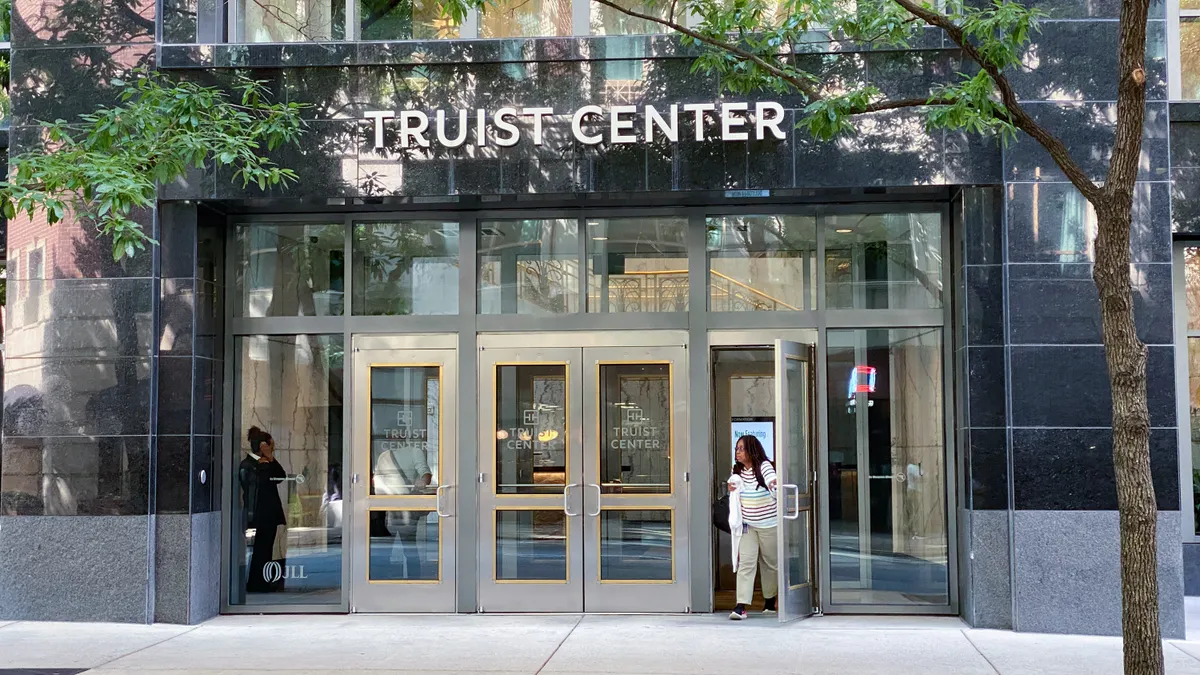
Six weeks into Mike Lyons’ tenure as CEO, Truist has tapped new leaders to drive execution of the bank’s strategy.
Dontá Wilson, Truist's chief consumer and small business banking officer, is leaving the bank. Wilson was the last person remaining from the executive management team that came out of the 2019 SunTrust-BB&T merger that produced Truist.
Shimna Sameer, a Bank of America alum who was hired in July to lead Truist’s wealth management division, will succeed Wilson in the chief consumer-banking role, Truist said Friday in a news release.
Truist has hired Jeff Warner, a 25-year veteran of PNC, to serve as chief small business banking officer. At PNC, Warner was most recently head of small business.
Also Friday, D. Steve Boland was named a vice chair at Truist “to help advance the bank's strategic agenda and support execution of the highest-priority initiatives,” the lender. Boland had been chief administrative officer and president of retail banking at Bank of America before retiring from the lender in 2025.
Boland, Sameer and Warner will all report to Lyons. The bank didn’t specify when Wilson would depart, but in a LinkedIn post Friday, Wilson referenced “support[ing] this leadership transition through the end of the year.”
“We've sharpened [consumer and small business banking]'s focus, added highly experienced leaders to complement our existing talent, and flattened the organization, all designed to drive the execution of our growth plan,” Lyons said.
With Sameer’s move, Truist elevated two wealth executives to co-lead the unit. Jeff Dunn, head of private banking, specialty wealth and institutional, and Bryan Cram, head of the bank’s wealth brokerage, will serve as interim co-heads of Truist’s wealth unit and report to Kristin Lesher, the bank’s chief wholesale banking officer, according to the release.
Truist also said Friday it’s signed an agreement to sell $7.7 billion of loans associated with LightStream, the bank’s unsecured personal loans platform, to global investment firm Carlyle, which is estimated to generate net proceeds of $7.2 billion.
The transaction is expected to close in the fourth quarter and represents “an exit from a non-core, loan-only business that is generating returns well below our targets,” CFO Mike Maguire said during the Charlotte, North Carolina-based lender’s third-quarter earnings call.
The loan sale is another outcome of an ongoing strategic review Lyons has overseen. Last month, the bank said it was selling $5.5 billion in near-prime auto loans associated with its subsidiary Regional Acceptance Corp., and repositioned some of its available-for-sale securities portfolio; the RAC sale, completed in the third quarter, generated $5.2 billion in net proceeds.
“We have operated too many nationally focused, standalone, single-product businesses like marine and RV, RAC, and LightStream, which have diverted attention and resources from growing our core deposit franchise,” Lyons said Friday.
Lyons, who was briefly CEO of payments processor Fiserv and served as PNC’s president prior to that, faces high expectations: Investors want to see a major reset at the $554 billion-asset bank, and Lyons needs a bold plan to bolster Truist’s profits and growth, analysts have said.
“The turnaround is fully in motion,” and leadership changes announced Friday “reinforce that message,” Jefferies analyst David Chiaverini wrote.
Despite the Southeastern super-regional’s positive attributes, “we haven’t performed up to the potential or expectations,” Lyons told analysts during the earnings call. Still, “we don’t need to reinvent Truist to win.”
“The biggest opportunity I’ve seen is just be clear on the strategy and then align our capital and resources against it,” he said.
“We found capital spread to a lot of areas that don’t either support our core strategy or areas where we have a clear right to win,” Lyons said, while other “important initiatives have not received the level of investment or attention required, which inevitably makes execution more challenging.”
He noted Truist’s branch footprint is solid but the bank hasn’t opened new or refurbished locations in some time. The bank also needs to add salespeople in areas such as wholesale and finish a build-out of treasury management, he said.
“You just don't sit in the footprint and grow and be successful. You have to put money into it. You have to go compete,” Lyons said. “And our people are ready to do that if we give them the investment, and that’s what we’re doing.”
The strategic review is set to be complete by the end of the year. Truist is narrowing its focus to relationship-based businesses where it has a competitive advantage and that offer attractive returns, he said.
Lyons sees opportunities for Truist to grow in small-business lending, as well as home equity, indirect auto and credit cards within consumer lending. He’s also eyeing lending growth within wealth and middle market banking.
And “from an operational perspective, we need to get back to basics, simplify how we work, remove unnecessary complexity, and eliminate low priority activities,” he said.
Truist is committed to delivering on its return on tangible common equity targets of 15% in 2027 and 16% to 18% in the long term, Lyons said.
“We’re clear-eyed about the work we have to do,” he told analysts. “I can assure you, we’re doing it with focus, clarity and urgency.”