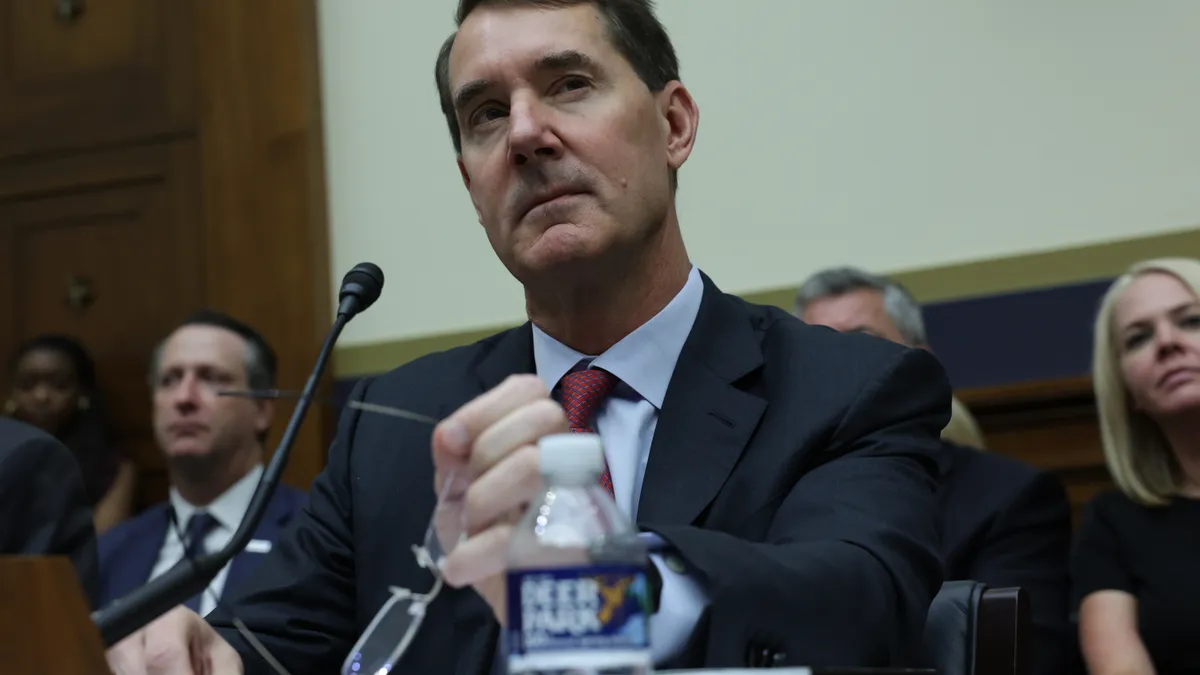
As bank merger-and-acquisition activity swells, PNC CEO Bill Demchak cast doubt this week on the possibility of a large bank deal occurring in the industry in the next couple of years.
Even if such a transaction were to come to fruition, Demchak said it would come with a high degree of execution risk.
“Some notion that I can do banker math and put two things together and wave a magic wand and actually execute and cause that outcome is a super dangerous notion,” the CEO of the Pittsburgh-based super-regional said Tuesday at the Goldman Sachs U.S. Financial Services Conference.
“A deal that was the same size as us, or even half the size of us, comes with material execution risk, compliance risk, systems risk, … degrees of complexity in doing operational conversion, personality conflict, dual heads of everything,” he said
PNC said in September it would acquire Colorado-based FirstBank for $4.1 billion. But it also signaled it’s forging ahead with an organic growth strategy, aiming to build 300 new branches by 2030.
Tuesday’s comments on the M&A outlook came after a Goldman analyst asked Demchak whether there’s a potential bank combination that concerns him from a competitive standpoint.
“If we wanted to even do anything, have you heard anybody come up here and say, ‘I'm interested in selling’?” Demchak said. “No, they all want to buy.”
Bigger bank deals that have been struck this year include Fifth Third’s pending acquisition of Comerica for $10.9 billion, Synovus and Pinnacle’s $8.6 billion merger of equals, and Huntington’s proposed purchase of Cadence Bank for $7.4 billion. Even Wells Fargo’s CEO has indicated the bank doesn’t need to buy another lender, but the option is there, where it wasn’t in recent years.
“Every small bank’s for sale,” Demchak said, but “they've driven a price up where most people who would be acquirers, even though they really want to acquire, struggle with any of the metrics associated with it,” Demchak said.
Demchak has been outspoken about the need for scale to compete with the likes of JPMorgan Chase and Bank of America, and he’s determined to double PNC’s size. But he’s also said the $569 billion-asset lender isn’t looking to pay “a silly price” for a “busted” franchise.
Demchak’s comments come as bank M&A activity soars, fueled by a more permissive regulatory environment for mergers and acquisitions and long-term consolidation trends in the industry.
In particular, the probability of deals receiving regulatory approval has increased considerably, and the lag time – during which regulators evaluate a possible transaction – has dropped dramatically, said Brian Graham, a co-founder and partner at financial services advisory and investing firm Klaros Group.
After announcing the FirstBank acquisition, Demchak said if PNC found another acquisition target like the Colorado lender, “we’d probably do it.” On Tuesday, though, he noted FirstBank is “the most unique bank I’ve ever seen,” and sought to convey the discipline PNC executives employ when it comes to M&A.
Demchak doesn’t see the regulatory window of opportunity to do deals closing any time soon, saying both sides of the aisle acknowledge it’s crucial to create challenger banks to the global systemically important banks.
But the CEO also bemoaned speculative chatter around industry M&A and its effect on shareholder sentiment.
“The market is way too focused on who's going to buy whom, as opposed to what is a good franchise,” he said. “There's absolutely no differentiation on a bank that is actually able to grow because it's growing clients and business, versus one who is mortgaging their future or just recovering from a disaster.
“There's way too much focus on” guessing the next bank buyers and sellers, he said.
For its $4.1 billion, PNC is getting a $26.8 billion-asset bank, but some have questioned the price point given the deal’s 3.8% tangible book value dilution and 3.3 year earnback period.
Demchak blasted critics looking at those metrics alone.
“You have bank deals getting done saying, hey, I have no tangible book value dilution, but, oh, I'm stopping share repurchases for the next 20 years, and I just bought this crappy-ass franchise that isn't going to make me any money,” he said. “You want to buy a good franchise where you get a good return on what you bought.”
PNC bought RBC Bank (USA) at one times book value in 2012, he noted, and it didn’t offer nearly the return FirstBank does. The FirstBank deal is expected to close in early 2026.
On Tuesday, he lamented that PNC’s stock lags other banks’ despite the super-regional’s financial performance, “all because people think I will do something stupid.”
“It's like the whole world has bet that I'm going to do something stupid to cause the stock to go down,” he said, “and I won't.”