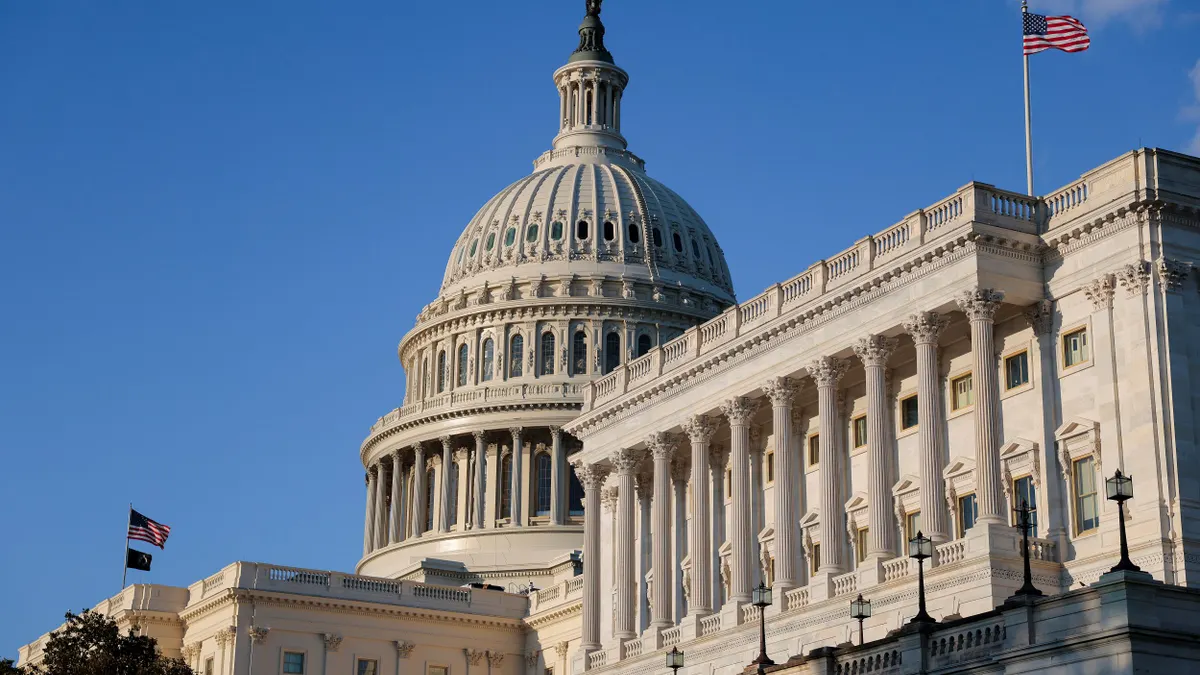
The Senate Banking Committee on Thursday approved a version of the Clarity Act – meant to establish cryptocurrency regulation – by a 15-9 vote.
Two Democrats, Sens. Angela Alsobrooks of Maryland and Ruben Gallego of Arizona, joined the panel’s 13 Republicans in giving the legislation a green light. It now will head to the full Senate, where it needs 60 votes to be fully considered. And even then, it must be reconciled with a House bill passed last July.
The bill advanced despite seemingly fluid negotiations.
Language concerning stablecoin yield, written by Alsobrooks and Sen. Thom Tillis, R-NC, survived intact. The language bars crypto firms from issuing rewards for stablecoin balances that are “economically or functionally equivalent” to interest-bearing bank deposits.
Bank trade groups, however, have argued that if stablecoin issuers are allowed to use third-party arrangements to work around the ban, money could flow out of the banking system.
To cement some Democratic votes, Senate Banking Committee Chair Tim Scott, R-SC, allowed previously discarded amendments to be included in the bill – but refused two amendments with squarely Democratic concerns: one, on stablecoin yields led by Sens. Jack Reed, D-RI, and Tina Smith, D-MN, and another on anti-money laundering from Sen. Catherine Cortez Masto, D-NV.
“What is the harm in letting us vote two more amendments that we wanted to vote on – one that is supported by law enforcement, and one that is supported by community banks?” Sen. Elizabeth Warren, D-MA, asked Scott at Thursday’s markup. “We're not here to try to make this a longer process. You still have all the votes. You can keep them out, but we at least like to have an opportunity to vote on these two amendments.”
Scott replied that the amendments that received last-minute consideration were of bipartisan concern.
“We made real progress with our Democrat colleagues, and this bill … will be better off because of it,” Scott said in remarks Thursday.
Reed, in contrast, said, “the definition of working together at a markup is allowing amendments to be called up and voted upon.”
Another demand that may be reconciled in future debates is a Democrat-led push to restrict elected officials from engaging in certain crypto-industry activities. That’s clearly aimed at World Liberty Financial, a crypto platform with deep ties to the Trump family.
In an interview with The Wall Street Journal, Eric Trump, President Donald Trump’s son, called that prospect “the ultimate hypocrisy.”
“The institutions that have exploited everyday Americans for decades are suddenly concerned about ‘fairness’ and ‘protecting investors,’” Eric Trump said. “It’s un-American.”
Banks – presumably the institutions to which Trump is referring – said the Clarity Act "should be strengthened further by tightening the prohibition on interest-like rewards for holding stablecoin while also allowing certain payment stablecoin transactions and activities to generate rewards."
"Without the necessary guardrails, stablecoin offerings are expected to draw away bank deposits and threaten local lending and economic activity across the country,” several banking trade groups wrote in a joint statement Thursday. “In that spirit, we will continue to work with senators in good faith to address this issue and improve the bill and its chances on the Senate floor."
It’s not a given that the Democrats who supported the bill in committee would do so in the full Senate.
Other lawmakers acknowledged the fight isn’t over.
Sen. Mark Warner, D-VA, told CNBC he had been in “crypto hell the last couple months” but hoped to continue working on the bill and “get to crypto heaven.”
“I guess I’m right now in crypto purgatory, but I’m looking forward to getting all the way there,” he said.
Scott, too, contrasted black and white in remarks Thursday.
“For years, the digital frontier was trapped in a regulatory gray zone,” Scott said. “Developers, entrepreneurs and investors were left with uncertainty. They faced confusion and enforcement actions, when instead, the government should have been crafting clear rules of the road.”
Warren, however, lamented that so much energy was spent on crypto when such digital assets are “at the bottom of U.S. voters' priority heading into elections.”
“Nothing made it into this bill that wasn’t approved by the crypto industry,” Warren said. "Our job is to serve the American people. Our job is not to advance a pro-industry crypto bill that will put American consumers, American investors and our national security and our financial system at risk.”