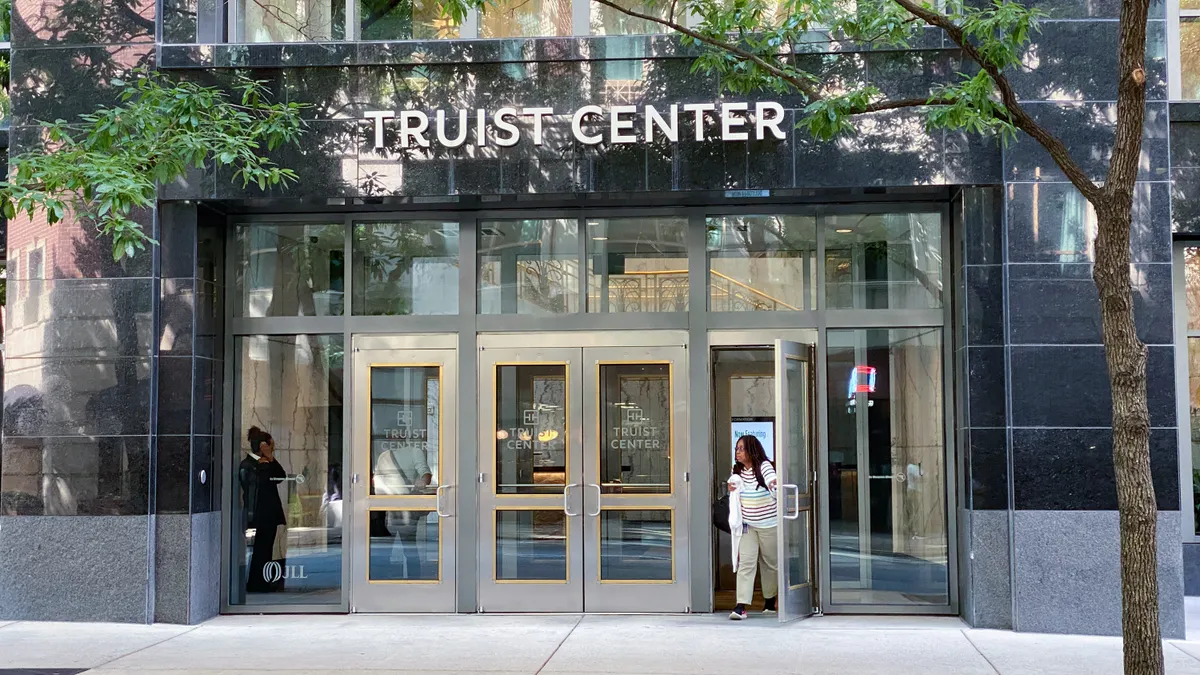
Truist has sharpened its efforts to grow business with mass-affluent customers, including by offering premier services at a lower access point than big-bank rivals.
The super-regional bank has invested in more capabilities and services for clients in its premier segment, with the goal of attracting new clients and doing more for existing customers, said Dontá Wilson, Truist’s chief consumer and small-business banking officer, in an interview.
That includes making the experience more personalized through analytics and artificial intelligence, enhancing the rewards proposition and installing more premier advisers inside branches, Truist said Tuesday.
Truist has also expanded its digital financial planning capabilities, allowing premier clients with $250,000 in combined deposits and investments to start the financial plan process and set goals, which advisers can see and reach out to clients about. The bank plans to expand digital planning access in the future.

The Charlotte, North Carolina-based bank has stepped up hiring, increasing premier adviser hiring by about 35% from a year ago, when it telegraphed intentions to boost mass-affluent business and build new branches in high-growth markets. Truist wouldn’t share its premier adviser headcount.
And AI is collecting client inputs and directing bankers to send clients down the right path, whether that’s to a financial adviser, premier banker or other point of contact at the bank, Wilson said.
Efforts are already bearing fruit, Wilson said. Truist reported second-quarter deposit production per premier adviser jumped 23% year over year, and premier adviser-led financial planning rose 9%, according to an earnings presentation. Average consumer and small business banking deposits increased 2% year over year, to $217 billion, in the second quarter.
The $556 billion-asset bank wouldn’t say how much it’s invested in the expanded strategy, but Wilson said it’s an ongoing effort. In addition to serving those already identified as premier, the lender is keen to bring other bank customers into the premier pool.
That includes those who bank with Truist already but have more assets outside the lender, or may be new to Truist entirely. With the baby-boomer wealth transfer underway, “when that transfer happens, 70% of the folks that inherit the assets change institution,” Wilson said.
Wilson estimated that opportunity at about $600 billion in deposits and $2 trillion of investments.
The opportunity is particularly enticing to the bank because a mass-affluent client’s lifetime value is six times greater than that of typical clients, Wilson noted. As their assets grow, such customers can also serve as a significant feeder to the bank’s wealth business, he added.
“When you look at how we're investing in all of consumer and small business, it's targeting getting everybody to a path towards premier,” Wilson said.
Wilson said the bank is working to expand premier rewards, going beyond rates and discounts. He pointed to access to the Truist Championship, an annual golf tournament in Charlotte, and clients being entertained there as an example of a more expansive rewards concept the bank is working on.
To be sure, Truist is far from alone in chasing more business with affluent customers. Big-bank peers such as Wells Fargo and PNC are among those that have signaled intent to grow that business.
Wilson said Truist’s offering is unique in that clients can access some financial education tools beginning at $100,000, and are assigned an adviser at $250,000. Many of the bank’s competitors require clients to have millions of dollars with that lender before they can access an adviser alongside self-serve components, he said.
Wilson also pointed to the bank’s virtual assistant, Truist Assist, and the ability for clients to push a button to reach a human if desired during that process.
“We’re making those steps easier because we’re giving them a digital option to start, and then we’re complementing it with humans,” Wilson said.
As lenders vie to serve mass-affluent clients, who wins “is really focused on who brings the best model together to be able to deliver for the clients,” Wilson said.
Truist’s prioritization of the advisory component, through personal and digital avenues, is a key way the bank seeks to “deliver the model better than anyone else,” Wilson said.
Last month, Truist said Bank of America veteran Shimna Sameer would lead its wealth management division, beginning in October. And Mike Lyons, formerly PNC’s president and Fiserv’s CEO, is set to take the CEO reins at Truist next week.
“They’re going to just help us accelerate growth,” Wilson said.