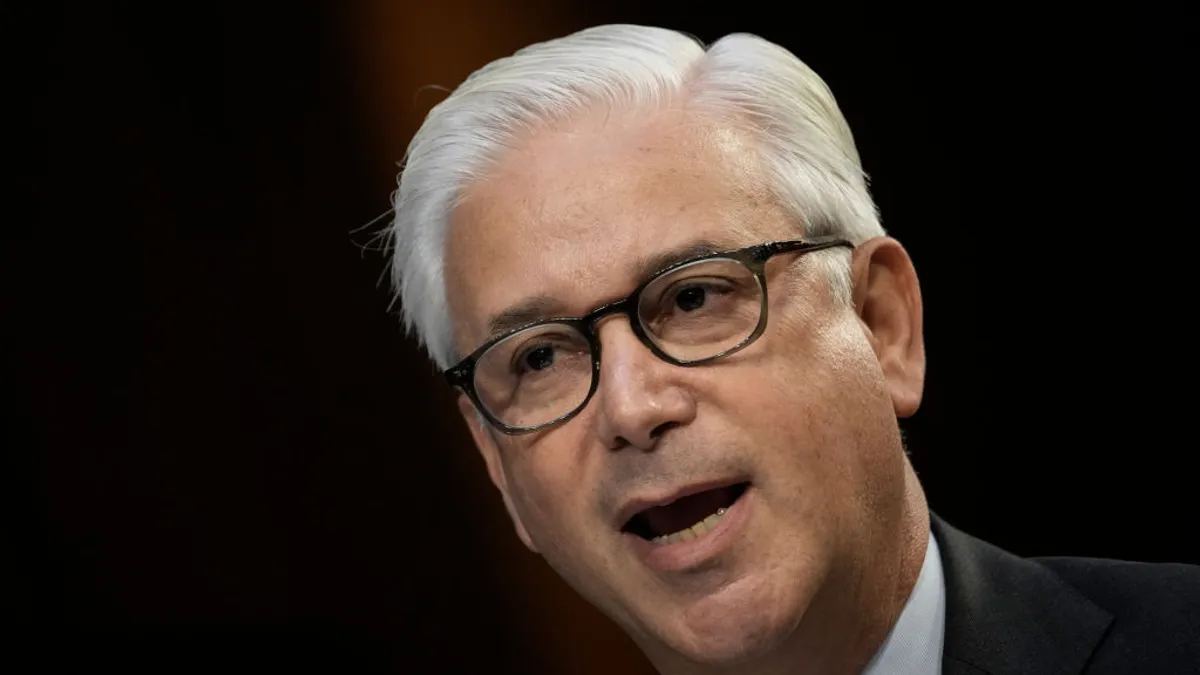
When Charlie Scharf kicked off the annual Goldman Sachs U.S. Financial Services Conference on Tuesday, a moderator noted the Wells Fargo CEO was last year’s first speaker, too.
It’s safe to say a lot has changed in the past 365 days. For one, the Federal Reserve in June lifted a seven-year, $1.95 trillion asset cap against Wells.
“We’ve got a lot of degrees of freedom to make decisions on the direction of travel [the bank might take],” Scharf said Tuesday. “The world is our oyster now.”
Wells had been putting roughly $2 billion to $2.5 billion per year toward resolving regulatory shortcomings and deficiencies, Scharf said. Now that freed capital can be invested elsewhere in the bank, Scharf said.
During Scharf’s tenure, San Francisco-based Wells Fargo has improved its return on tangible common equity from 8% to more than 14%. But growth has stalled in some areas of the bank.
The asset cap largely prevented Wells’ consumer bank from proactively building its deposit base, he said.
“There’s nothing [now] that we think stands in the way of having returns and growth equal to the best in class,” Scharf said of that business. “With [the cap] gone, we can now compete on a much more level playing field.”
But building Wells’ deposit base doesn’t necessarily mean engaging in mergers and acquisitions, even though the regulatory environment seems more amenable to larger bank M&A.
“We feel so comfortable in the scale we have,” Scharf said. “We think we’ve got so many opportunities to grow the franchise, … we feel no pressure to do anything, and that is a great place to be.”
Scharf’s main concern on the consumer side is “creating the organic growth engine inside the company” and taking back share in the market, he said.
“Our ability to take share now is dependent on our ability to execute with the competitive advantages that we have. Where that stops, that’s not today’s issue,” Scharf said.
That doesn’t mean Wells doesn’t think about M&A; it’s just that the “hurdle rates” are high, Scharf said.
A deal would have to bring a strong financial impact and be strategic, he said.
“We have no interest in doing something which could just add a little bit of earnings to the company,” Scharf said. “The driver of our conversations internally are predominantly the organic opportunities that we have.”
AI, too, has advanced rapidly since Scharf last took the Goldman conference stage.
Wells, for its part, has rolled out generative artificial intelligence in its engineering department. Scharf said the bank is 30% to 35% more efficient at writing code than it was before AI.
“We’ve not reduced the number of people we have coding today, but we’re getting a lot more done,” he said.
As for headcount at the bank as a whole, however, Scharf has overseen a reduction from 275,000 to about 210,000, he said, and “we do expect to have less people as we go into next year.”
“We’ll likely have more severance in the fourth quarter than we’ve had in the first part of the year,” Scharf added.
Scharf called the long-term impact of AI on the bank’s headcount “extremely significant.”
“It doesn’t mean that it’s going to happen next year, and it doesn’t mean that it’s going to happen in every area of the company,” he said. “[AI is] not going to totally replace humans, but it does create an opportunity to do things significantly different.
“We’re trying to be very thoughtful about what it means for retraining workforces, use attrition as our friend,” Scharf added. “It’s a reality, and I think it’s a positive reality. But we’ve all got to be focused on what it means for the future.”