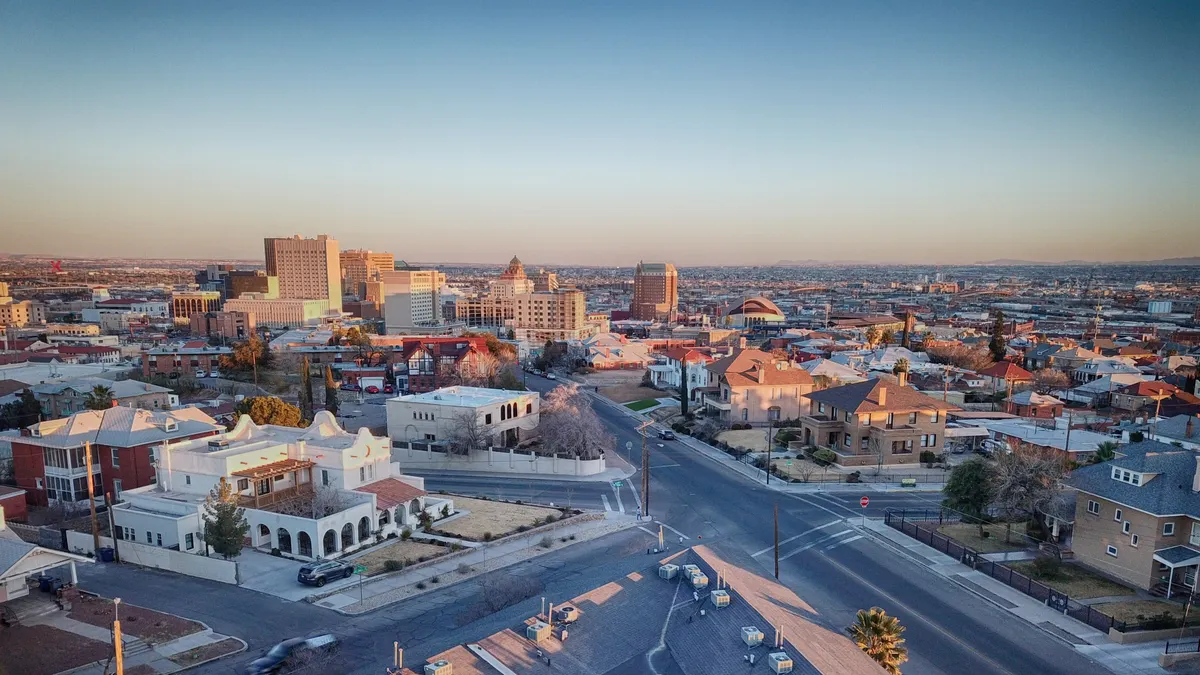
Capital One may be one of about 350 commercial banks serving the state of Texas, but an executive said the lender seeks to be a “steady partner” amid consolidation in the state’s banking landscape.
The McLean, Virginia-based company has provided commercial banking services in Texas since 1995. The corporate bank has a $10 billion loan portfolio in the state, and $683 billion-asset Capital One has about 9,000 employees there, said Bob McCarrick, president of the lender’s corporate banking segment.
Broadly, Capital One’s commercial bank, which exclusively focuses on middle market customers, has about $90 billion in funded assets, and the corporate bank makes up about two-thirds of that, McCarrick said in a recent interview.
Although Capital One’s corporate bank covers Texas by industry verticals such as healthcare and energy as well as by product type, the traditional banking market is largely where the lender competes in Texas, and that’s “a heavy incumbency business,” said McCarrick, who’s also North Texas market president.
“If you're a bank and you build a relationship with a company, typically you retain that relationship as long as you want, and you typically only see turnover in that relationship if the company is doing something transformational that perhaps the current bank can't serve,” he said. “Maybe there's underperformance where the current bank is just fatigued. Or that company might get acquired, where then you see turnover to a different relationship.”

Bank consolidation – which Texas has seen plenty of in the past year-plus – can cause disruption, and rivals often seek to capitalize on that by poaching customers and employees.
Bank leaders in Texas expect strong loan growth “given recent disruption paired with strong macro trends for the state,” KBW analysts wrote in a note last month, after meeting with executives in the state. “While M&A in the state has taken a breather after several larger transactions, several banks continued to talk up M&A potential from here.”
Texas’ population and business growth have made it a hotbed of banking activity, drawing increased attention from the likes of the biggest banks such as Bank of America and out-of-state regionals like Wisconsin-based Associated Bank, while in-state players such as Frost Bank, Prosperity and Texas Capital defend their home turf.
Ohio regionals Fifth Third and Huntington have each made acquisitions to dig deeper into the state. Huntington, for one, discovered during the due diligence process that many of the commercial customers it hoped to snag were already clients of Dallas-based Veritex, according to Huntington CFO Zach Wasserman.
“It's really, really hard to win new business, to grow new business, in a heavy incumbency market,” which is why many banks have pursued growth through acquisitions, McCarrick said. “Texas is just a difficult market to compete in.”
That has Capital One zeroed in on differentiation, he said.
“It's through domain, it's through product, it's through channel, it's through industry, and being a solutions-oriented provider, in building both professional and personal relationships with the client, where they look at you as a trusted adviser,” McCarrick said.
Advice the bank aims to provide goes beyond banking-related services, including how Capital One views and interacts with artificial intelligence tools, McCarrick said. That’s the guidance clients are most interested in at the moment, he added.
Bank consolidation can also elevate the value of stability and sector knowledge, and Capital One aims to be “a steady partner for businesses navigating changes in their own banking relationships,” he said.
That includes the bank’s consistent focus on the middle market, which is well served but not necessarily so in and out of economic cycles, he contended. Bigger banks tend to migrate toward larger deals and companies “where there’s more revenue dollars per client and a higher opportunity for product cross-sell,” he said.
Industry expertise influences how the bank builds products and services and approaches risk, and McCarrick sees both giving the lender an edge.
Capital One doesn’t set growth targets, he said. Amid Texas’ intensely competitive landscape, the bank is focused on being “better, not just bigger,” and maintaining credit discipline while pursuing segments “where we have high confidence in credit quality, collateral strength, and structural protections,” McCarrick said.