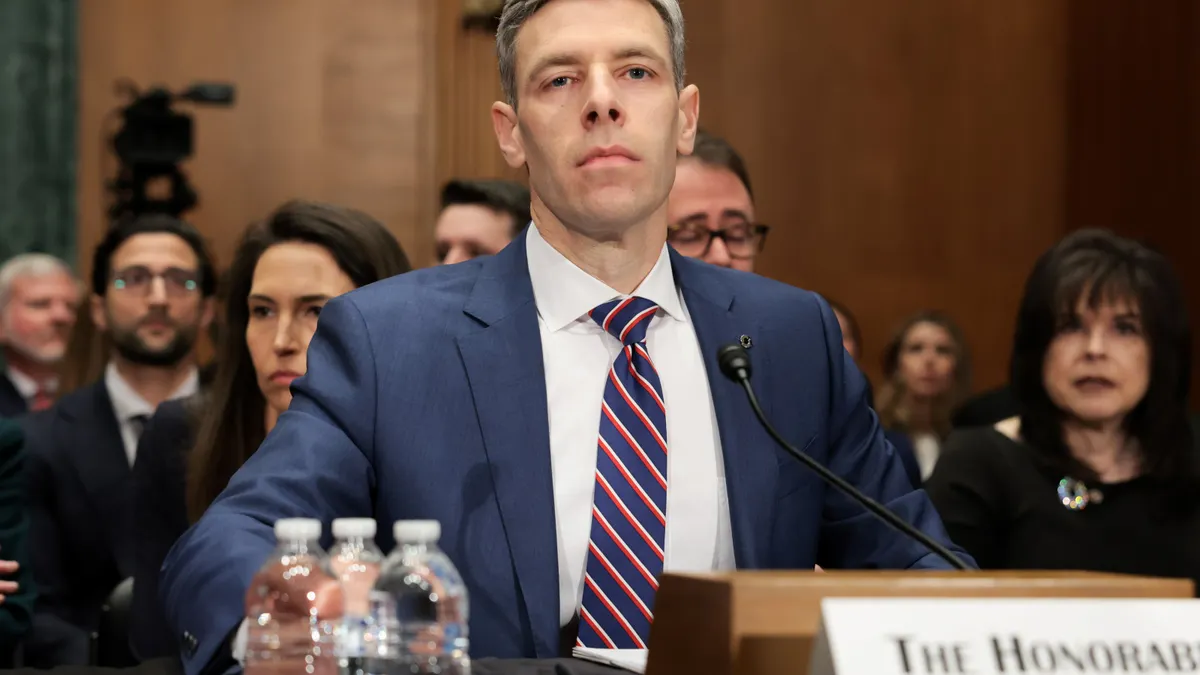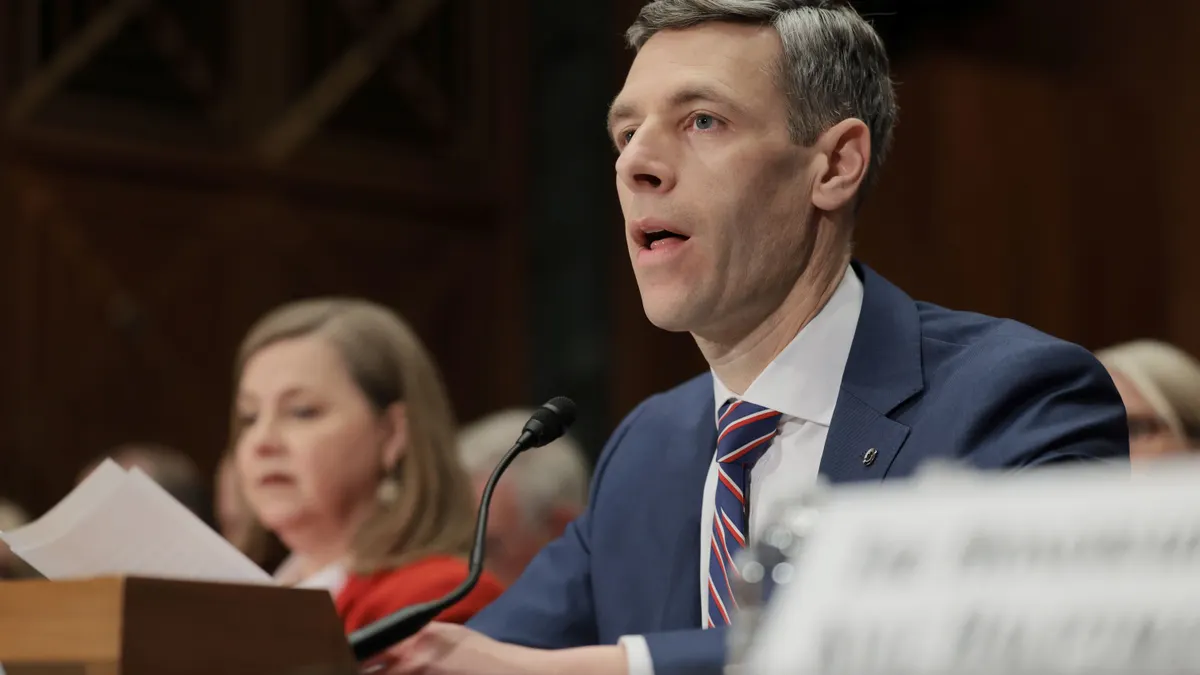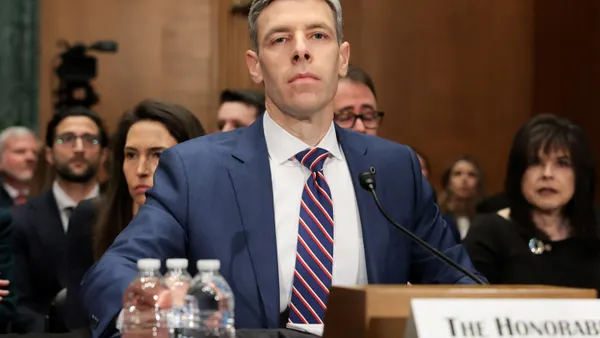
Brian Johnson, the Trump administration’s nominee to lead the Consumer Financial Protection Bureau, told senators Thursday he would pledge to “have an open mind about staffing levels” at the agency, if confirmed.
“My understanding of the state of litigation is that I’ll have the opportunity to make those judgments,” Johnson told the Senate Banking Committee.
A federal judge this month allowed Johnson 60 days, if confirmed, to review a plan that would cut the CFPB’s workforce by 53%. The CFPB and the union that represents the bureau’s employees have been locked in a 17-month legal battle over Acting Director Russ Vought’s efforts to shutter the bureau or, at the very least, lay off swaths of workers.
Under Vought, whose term ends Aug. 1, the CFPB has also rescinded previous guidance, dropped enforcement actions and lawsuits, and scrubbed the agency’s website of prior administrations’ actions.
When asked Thursday whether he disagreed with any of Vought’s decisions, Johnson told Sen. Ruben Gallego, D-AZ: “None come to mind at the moment.”
However, when Sen. Chris Van Hollen, D-MD, asked Johnson if he “would like to eliminate the CFPB,” the nominee said, “that’s not my intention,” adding that the agency “is a creature of statute.”
President Donald Trump tapped Johnson in June to lead the CFPB. Johnson served as the bureau’s deputy director during Trump’s first term but has worked since November 2024 as a vice president and U.S. card compliance officer at Capital One.
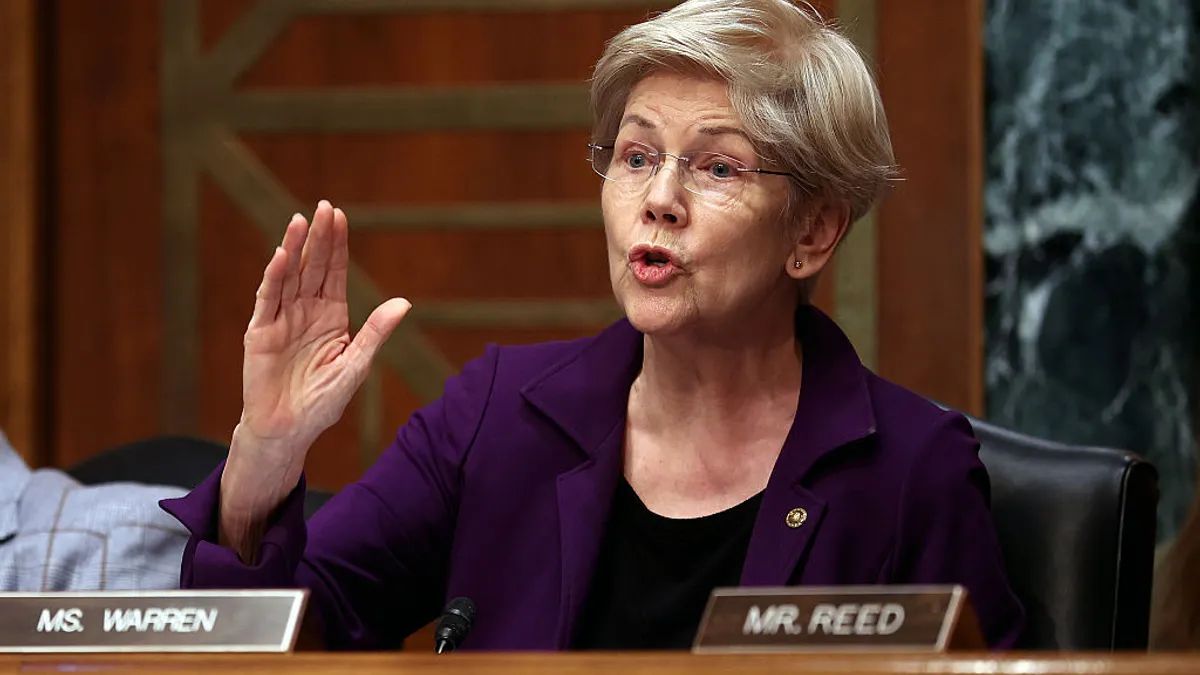
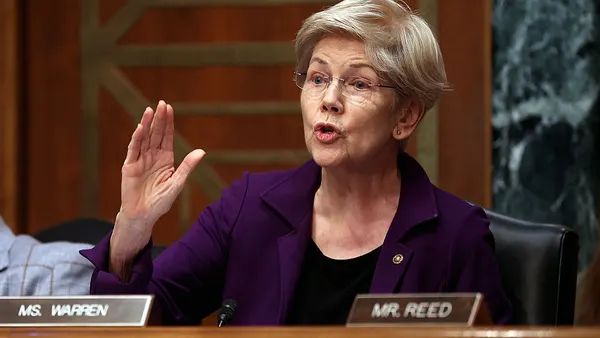
That development – and particularly, the CFPB’s decision in February 2025 to drop a lawsuit against Capital One less than a month after the bureau, under its Biden-era director, sued the bank – prompted Sen. Elizabeth Warren, D-MA, to probe for conflicts of interest.
Warren wrote Vought on Wednesday, asking for any correspondence between Johnson and any CFPB employees since November 2024.
Warren wrote a similar letter to Capital One CEO Richard Fairbank last month, asking how involved Johnson may or may not have been “in the enforcement action or in advising Capital One how to avoid responsibility for its alleged misconduct.”
The bank responded that it is “not aware of any outreach by Mr. Johnson to the CFPB on Capital One’s behalf related to [the] lawsuit.”
Warren argued Thursday that the CFPB abandoned its lawsuit against Capital One shortly after the bank donated $1 million to Trump’s inauguration.
Financial firms that give to the president “get actions from the CFPB against them dropped,” Warren asserted, noting 42 cases that were active when Trump retook office have been settled.
The senator then asked Johnson, hypothetically, whether he would alert Congress or the Federal Reserve’s inspector general if he found that the White House applied pressure to get an enforcement action against a donor company dropped – or an investigation into a Trump family member suspended.
“With respect, I dispute the premise of the question,” Johnson said.
“So the answer is no,” Warren replied. “You will not try to hose out the corruption.
“The CFPB is currently being used as an arm of President Trump’s ongoing corruption, including his corporate pardon machine,” she added. “Your answer indicates you’re just going to keep that machine humming.”
Johnson testified that his three priorities at the CFPB would be protecting consumers, promoting accountability at the agency, and modernizing the bureau’s operations.
“Where the CFPB tries to remake markets according to an ideological agenda, it deprives consumers of choice, restricts their access to financial products and services, and drives up costs for providers which are ultimately borne by customers and investors,” he said.
Warren, however, referenced the CFPB’s workforce-reduction plan, which would trim the bureau’s contingent of examiners.
“Mr. Johnson, does going from 350 examiners to 77 examiners make it more or less likely that companies like your current employer – Capital One – will get away with hurting consumers?” she asked.
“Senator, I believe it depends on the CFPB’s examination strategy,” Johnson replied.
Johnson this month pledged to recuse himself from any matters involving Capital One for two years if he is confirmed. The agreement also indicated Johnson agreed to repay to Capital One an anniversary bonus from last year and 50% of a sign-on bonus that he received in 2024, but that the bank “has determined that I will not be required to repay any portion.”
“They must be really excited about getting you confirmed,” Warren said Thursday.
Johnson’s appearance before the Senate Banking Committee came a week after Vought testified to the same panel, saying the CFPB “remains structurally defective,” and should not exist in “its current form.”
Johnson’s take sounded slightly modified.
“The CFPB is capable of great good,” he said. “However, I think there are deficiencies in the current legislative structure, and I have advocated in the past for changes to the CFPB's authority and structure to ensure that it's better able to execute its mission.”
Also Thursday, the Senate Banking Committee voted along party lines to advance John Crews’ nomination to join the board of the National Credit Union Administration.
Kyle Hauptman, the NCUA’s chair, has been tapped to join the Public Company Accounting Oversight Board. Crews would likely replace him if confirmed.