Citizens is mulling how it can bolster the value it offers retail customers, amid efforts to market its consumer bank toward mass-affluent clients, said Matt Boss, head of the consumer bank.
The regional lender has an opportunity to better reward customers for their overall relationship with Citizens, Boss said in a recent interview.
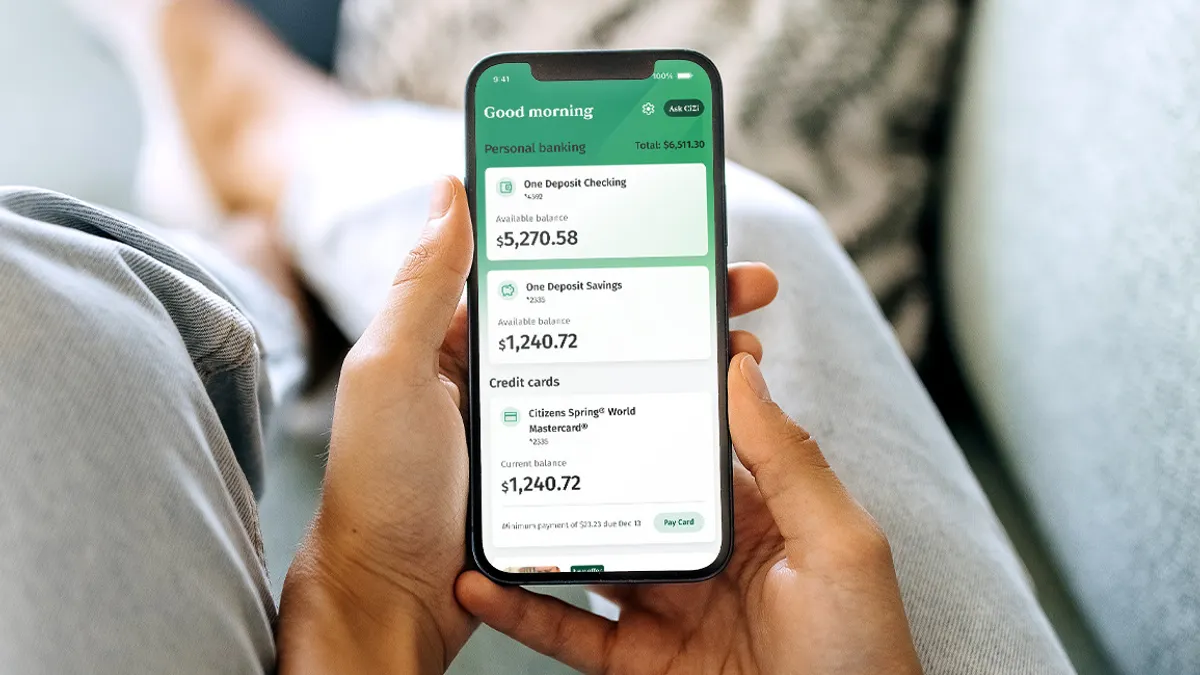
To that end, the $227.9 billion-asset bank is “making small tweaks every day,” he said, and pointed to the bank’s new mobile app as a venue for distinguishing “how we talk to customers and what we offer customers.”
Boss declined to elaborate on what a more rewarding experience might ultimately look like for the bank’s customers, saying the effort is in “early innings.”
Considering why customers should choose Citizens and the value they get from their relationship with the bank has been an area of strategic focus during Boss’ first year in the role. Boss was previously head of U.S. consumer banking at TD Bank.
Typically, regional banks “tend to score very, very well on the trust side, on the community side, on the people side,” while money center banks skew “more towards modern, more towards technology and more rewarding for a relationship,” he said, referencing an external survey of bank customers and non-customers.
Boss pointed to Bank of America recently announcing an overhaul of its rewards program, for example. PNC, too, has done the same, as a number of lenders seek to deepen relationships and get customers to do more with them.
Providence, Rhode Island-based Citizens also offers student lending, home equity, mortgage and credit card services, and “how you bring those together to reward customers and the experience that you create around that, [there’s] opportunity for us,” Boss said.
CEO Bruce Van Saun, in an appearance at a Barclays investor conference last week, said the regional lender has sought to identify areas of banking where Citizens can be distinctive. Serving the mass affluent in the consumer bank brings bigger non-interest-bearing deposit balances and opens the door to handling wealth needs, he said.
In the first quarter, Citizens’ average deposits rose 1% quarter over quarter and 5% year over year, to $181.3 billion, fueled by growth in the lender’s private bank. Interest-bearing deposit costs dropped 16 basis points to 2.04%.
Boss also sees potential gains from Citizens’ new mobile app, which was rolled out to its entire retail customer base by the end of April.
The revamped app has a more modern look and feel, about 400 new screens and 65 new types of actions, he said. It offers faster search capabilities and refined transaction detail – updates that were based on customer input – as well as spending summaries and live agent access, a bank spokesperson said.
More important is the capability the new app gives the bank, he said. Citizens can release new features, functions and services more frequently, and it plans to do so about once every two weeks through the rest of this year, he said.
“It’s been a real leapfrog forward,” he said.
The app is also built to foster stronger engagement with customers through communications or offers, he said.
“We've got a lot of opportunity to better … commercialize our digital channels,” he said, pointing to credit cards as an example.
Since Citizens launched a new credit card suite last June, only 5% of credit card sales occur within the digital channel, which is “far below benchmark,” Boss said.
The bank recently rolled out a single-touch pre-qualification for its existing customers. “You're going to start to see that ability to engage customers both on the servicing side, but also the communication side, dramatically ramp up,” Boss said.
With the credit card relaunch, the lender wanted to double down on relationship-based business, deepening ties with its customers. The share of consumer bank clients with a Citizens credit card is just above 15%, and “should easily be at 25 or 30%,” Boss said, so there’s “ample room to run.”
Boss acknowledged that Citizens’ consumer bank strategy may not look much different than other lenders’.
“What really matters is your ability to execute, and your ability to do it in a really aligned way around a common purpose,” he said.
Boss also said Citizens is unique in maintaining focus on its core markets, “where others may be expanding elsewhere.”
There’s more benefit for the bank to open a branch in an existing market than to build somewhere new, he said, given the amount of brand-building work required with the latter. Citizens currently has about 1,000 branches.
“The 14 states we operate in today offer more than enough opportunity when it comes to the consumer bank,” he said.
The New York metro area has been Citizens' fastest-growing region for deposits, and Van Saun said at the investor conference there’s still plenty of “juice left to squeeze out of the lemon there.”
Citizens has 170 branches in that area, with about a 4% branch share, Boss said. However, average deposits per Citizens branch is just under $100 million – far below the market average, he said.
To further mine that market, Citizens plans to add branches there over the next 10 years, Boss said. He declined to specify any target number, however.
The bank aims to grow its share both with “new locations – creating that network effect for greater density – and doing more with what we have,” Boss said.
In the rest of its footprint, Citizens plans to reformat and reposition some locations. Like other lenders, the bank has grocery store locations that no longer align with branches’ advice focus, he said.
“I don’t see our number of locations changing dramatically, but the types and the quality of locations will,” Boss said.