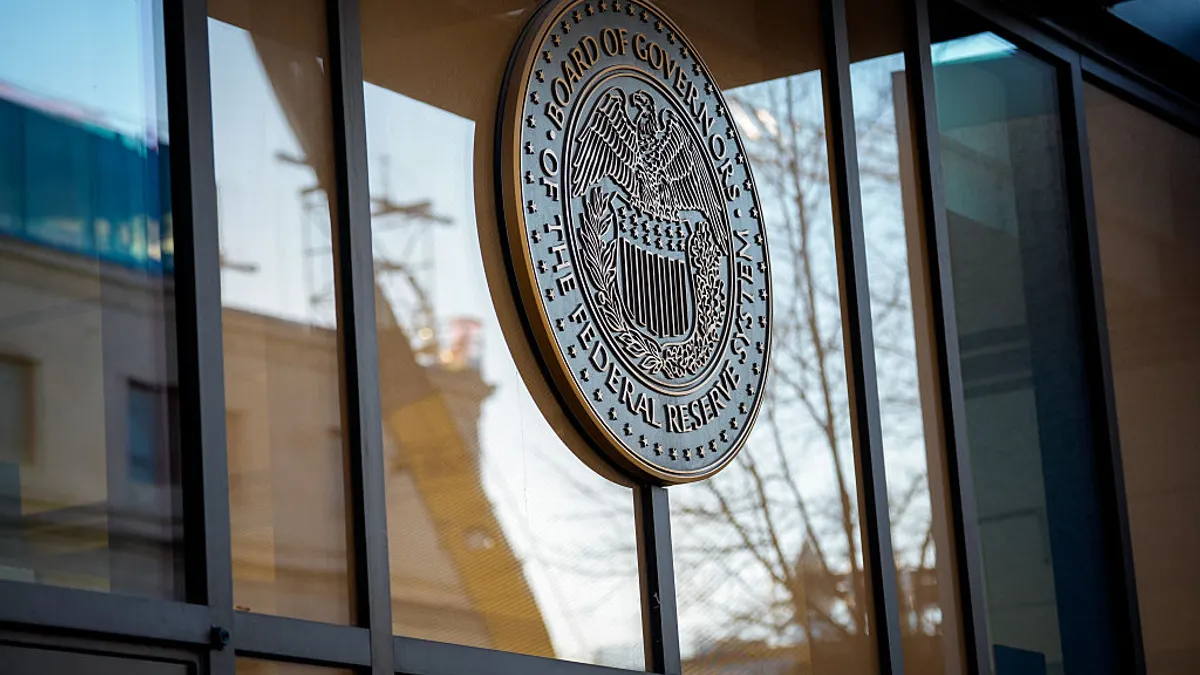
The Federal Reserve and Federal Deposit Insurance Corp. signed off on the resolution plans, or “living wills,” of the U.S.’s eight global systemically important banks, finding no shortcomings or deficiencies, the agencies said Friday.
Additionally, JPMorgan Chase, Bank of America, Citi and Goldman Sachs have “adequately addressed” a shortcoming the agencies found in 2024 in relation to the banks’ derivative portfolios.
Citi, for example, “has made material enhancements to its resolution forecasting systems, models and data,” and in showing how a wind-down of the bank’s derivatives and trading portfolio would affect resolution capital execution need and resolution liquidity execution need, the agencies said.
Further, Citi has developed a new financial forecasting system “to produce timely, material entity-level financial statements and daily reporting throughout the resolution time horizon,” has strengthened its data control framework and can now model multiple macroeconomic and firm-specific scenarios and “adjust assumptions based on stress environment and management actions,” the agencies said.
In a note seen Tuesday by Banking Dive, Citi said its “Transformation has allowed us to rebuild … from the ground up and has been a core driver of addressing legacy issues identified by our regulators, as evidenced by the feedback on our 2025 Resolution Plan and closure of our 2023 Shortcoming.”
In a letter published Friday, the Fed and FDIC said Bank of America “has enhanced its global wind-down tool to capture timely and quality financial data and has developed the capability to use dates outside its business-as-usual production process for spot derivatives and trading positions in estimating resource needs associated with unwinding the derivatives portfolio.”
JPMorgan Chase, meanwhile, “has developed the capability to adjust macroeconomic and financial market-related scenario inputs” when simulating an unwind of its derivatives and trading portfolio and can rapidly update its resolution forecast metrics,” the agencies told the bank in a separate letter.
Goldman, for its part, can now segment its derivatives portfolio to show trade-level and counterparty-level characteristics and “allow for variation in novation assumptions,” the agencies wrote in a letter published Friday. “[Goldman] has improved flexibility and speed for timely updating derivatives winddown assumptions and for quantifying the effects of preferred and alternative derivative exit strategies on [RCEN] and [RLEN].”
Every two years, the nation’s global systemically important banks are required to submit their strategy for orderly resolution in the event of material financial distress or failure. Letters published Friday came in response to plans the banks submitted by a July 2025 deadline.