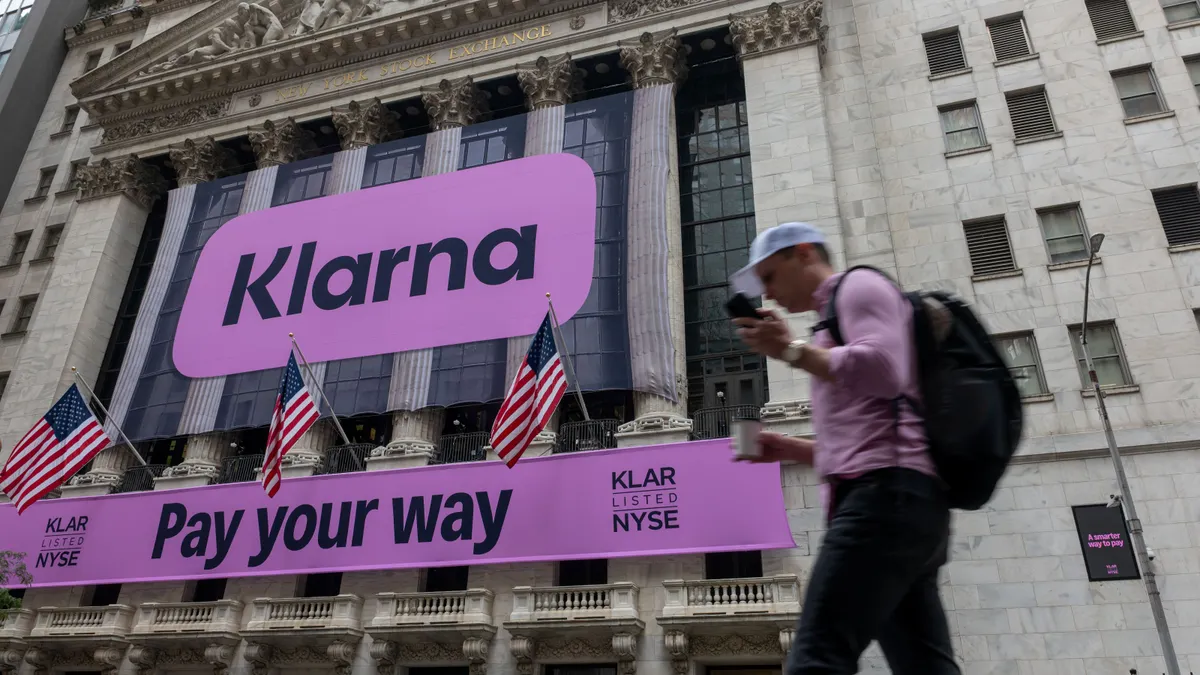

Buy now, pay later juggernaut Klarna is banking on delivering more financial services.
To that end, the Swedish company applied with the Federal Deposit Insurance Corp. and Utah’s Department of Financial Institutions on Monday for a charter to run an industrial bank.
Klarna already operates as a bank in Europe, under a license it has had since 2017, but in the U.S. it has partnered with financial institutions, often WebBank, to offer some of its array of financial services.
A spokesperson for the company declined to comment on other bank partners or intermediaries.
Now, it’s seeking more control over those pursuits, and the chance to add more financial services, according to a press release the company issued Monday. Klarna is also suggesting it will inject more competition into the U.S. market.
“Our own banking license is the natural next step, giving customers tools to borrow responsibly and build financial confidence, while bringing greater competition, innovation, and choice to consumers and merchants alike,” Klarna’s CEO, Sebastian Siemiatkowski, said in the release.
While the company’s main office is in Stockholm and it registered in London for its initial public stock offering last year, it is increasingly focused on the U.S. The company’s largest market, by revenue, is the U.S. and most of its investors are in the U.S., a spokesperson said by email.
Klarna was founded in 2005 as Kreditor, and changed its name in 2010. After the company sold stock to the public for the first time last year, the shares have lost about half their value as stocks in the fintech industry swooned.
Bringing banking in-house
Klarna isn’t the only payments tech company seeking to bolster its financial services by way of a banking license. Digital payments pioneer PayPal and rival buy now, pay later company Affirm have also applied for ILC charters in recent months.
Siemiatkowski has been aiming to disrupt the U.S. market for financial services from early on. Klarna’s trademark BNPL service has already provided U.S. consumers with an alternative to the traditional banking and card offerings.
If the company wins approval for its own U.S. bank license, it said it would bring its banking operations in-house, presumably cutting out third-party partners to some extent despite its reference to “valued partner banks” in the release.
Still, with help from those partners, Klarna has built a significant U.S. consumer appetite for its services. Klarna has extended $91.3 billion in credit to millions of consumers in the U.S. since 2019, with hundreds of thousands of merchants using the company’s services as well, according to the release.
Worldwide, the company has about 119 million active consumers using its services and caters to about 1 million merchants, including Sephora, H&M and Adidas, in 26 countries, according to its website.
If approved for the bank license with FDIC insurance, Klarna’s bank will operate as a subsidiary of the company, and will be headed by Gary Harding, formerly the CEO of Milestone Bank and Prime Alliance Bank.
Politics engulf bank licenses
The type of banking license Klarna seeks has become a political point of contention.
Some Republican and Democratic lawmakers, with backing from the banking industry, have argued that an ILC charter exempts companies from the definition of a “bank” under the Bank Holding Company Act. As long as ILCs don’t offer demand deposit accounts, they can bypass oversight by the Federal Reserve, the politicians contend.
In January, Sens. John Kennedy, R-LA, and Andy Kim, D-NJ, introduced a bill to close what they called the “shadow banking loophole.” The bill is now sitting with the Senate Banking Committee.
The trade group Independent Community Bankers of America said in May that cutting the Fed out of ILC supervision “leav[es] a dangerous gap in safety and soundness oversight and introducing unnecessary systemic risk into the banking system.”
Last year, Kim and Sen. Elizabeth Warren, D-MA, proposed a moratorium on commercially owned ILC charters until such entities are defined as “banks” under the BHC Act.
Still, Trump-appointed regulators have signaled increased acceptance of ILCs. FDIC Chair Travis Hill last year touted the ILC charter as one of a handful of ways to boost the establishment of new banks.
Car maker Stellantis received approval in May to launch an ILC and other car makers, including Ford and GM, got green lights in January. Investment firm Edward Jones followed in February.