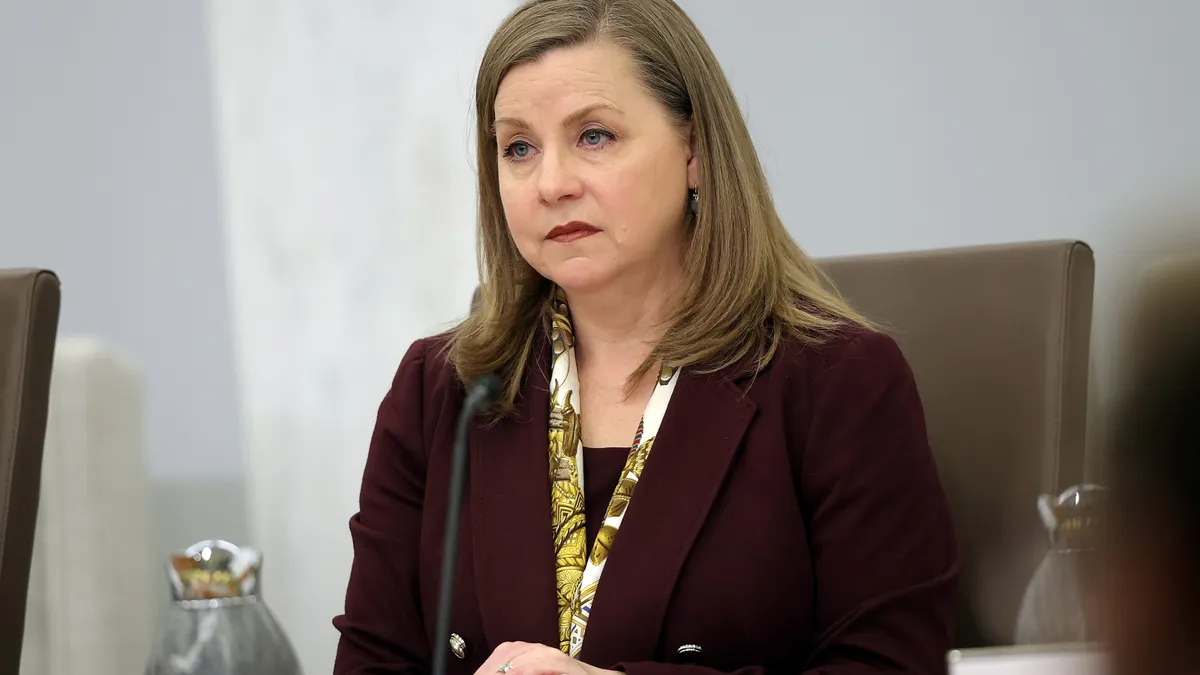
The advocacy group Better Markets sued the Federal Reserve board and its vice chair for supervision, Michelle Bowman, on Thursday, alleging secret meetings with bank CEOs turned the capital-requirements rulemaking process into a “charade.”
Better Markets asserts Bowman met with JPMorgan Chase CEO Jamie Dimon, Goldman Sachs CEO David Solomon and others during the comment period for a capital-requirements overhaul the Fed and other regulators proposed in March.
Under the proposal, the nation’s largest banks would have to hold 1.4% more in common equity tier 1 capital than they do now, but in tandem with changes to stress tests and the surcharge that global systemically important banks pay, the overall requirement would drop 4.8%.
Dimon, in particular, blasted parts of the proposal as “frankly nonsensical” in his April letter to shareholders. Just over a week later, during JPMorgan’s first-quarter earnings call, Dimon’s colleague, CFO Jeremy Barnum, labeled the G-SIB surcharge “miscalibrated.”
In its lawsuit, filed in the U.S. District Court for the District of Columbia, Better Markets cited press coverage – also from April – reporting that Bowman did not expect aggressive pushback from banks on the capital proposals, and that she told bank CEOs to stop asking for carve-outs.
When meeting with bank CEOs, Better Markets alleged, Bowman directed the banks on what to say – and what to leave unsaid – in public comments on the capital rules. She allegedly emphasized that feedback should be “limited and specific.”
But in doing so, Better Markets argued, comments overstate their support for the proposals and minimize disagreement, manipulating the process to achieve a predetermined result.
“The Fed is supposed to be an honest broker when enacting rules,” Better Markets CEO Dennis Kelleher said in a statement Thursday. “It’s not supposed to turn that process into a charade by secretly meeting, coaching, and coordinating with those banks to rig key financial protection rulemakings. That’s not regulation or supervision. That’s corruption.”
Neither the Fed nor Bowman immediately commented on the lawsuit. They have 60 days to submit a response to the court regarding the complaint.
Bowman testified in June to the House Financial Services Committee that she “did not direct anyone about their comments for the rule,” adding that it was her “responsibility” to engage with bank leaders.
“These are not inappropriate meetings,” she said at the time. “Our comment process is open.”
Better Markets argued otherwise Thursday. The advocacy group asked the district court to declare the rulemaking “fatally compromised” and force the Fed to withdraw the capital proposals and start fresh. It also seeks a court order requiring that Bowman and any other Fed official involved in the alleged activities recuse themselves from the capital-requirements rulemaking process.
Bowman and the Fed violated due process “by creating and presiding over a … pretextual rulemaking proceeding in which critical aspects of the outcome were settled in secret with the regulated industry rather than as a product of genuine open deliberation based on an uninfluenced public record,” Better Markets asserted.
“A record rigged in this manner has denied Better Markets its right to meaningfully participate in the rulemaking,” the advocacy group wrote. “The rulemaking process was designed to enable informed and uninhibited public input for agencies to consider in adopting rules that have the force of law – not be a mere formality to give cover for secret collusion or manipulated, pre-determined outcomes.”
Bank capital requirements have been among the most contentious Fed rulemakings of the past decade. During the Biden administration, the Fed sought to increase capital requirements by 19%, and later 9%, for the biggest banks. Both efforts met vehement opposition from banks, as well as Republican lawmakers.