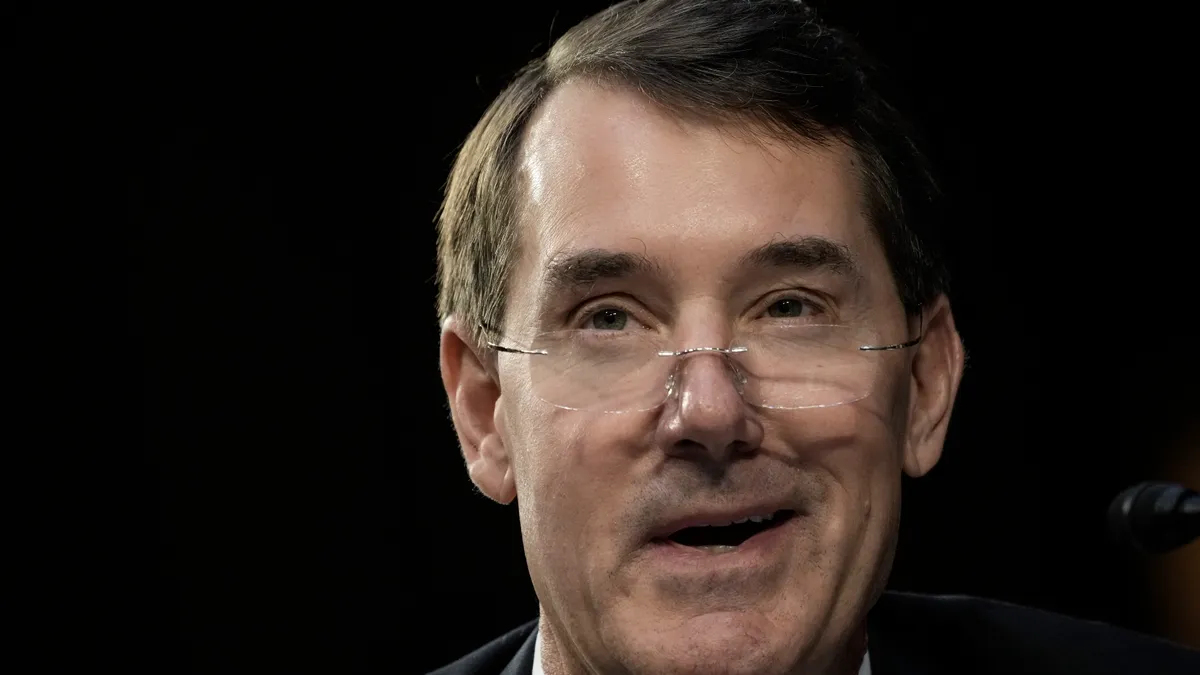
First Horizon CEO Bryan Jordan said he’s focused on building the business for the next 165 years, but he’s not ruling out a different outcome amid industry consolidation.
Jordan favors “optionality” for the Memphis, Tennessee-based regional lender, whether that’s related to the bank’s position as a possible buyer or seller, or making room on its balance sheet.
First Horizon, which has about $84.3 billion in assets and operates within a 12-state Southern footprint, is “not oblivious” to sustained industry consolidation, Jordan said during a recent interview.
“We operate it today with a long-term mentality,” he said of the business. The bank, founded in 1864, currently employs about 7,400 people.
Building an attractive franchise, cultivating a strong customer base and differentiating the bank’s strategy position First Horizon either “to be an acquirer, to fill in through M&A, or at the other end of the spectrum, to be a participant in consolidation,” Jordan said.
The bank has also raised its profile with a new office space in Charlotte, North Carolina, where it’s the anchor tenant in a 24-story tower in the city’s South End neighborhood. First Horizon employs about 300 people in the Charlotte office, with plans to grow to 400 by the end of 2027, mid-Atlantic Regional President Laura Bunn said at a grand opening event Nov. 18.
First Horizon strives to “build something that is truly differentiated for customers and communities. And that doesn’t limit your optionality; it probably expands it over time,” he added.
First Horizon is no stranger to merger and acquisition speculation. Canadian lender TD offered to buy the bank in 2022 in a $13.4 billion deal, which was ultimately terminated in 2023 partly due to regulatory scrutiny of TD’s anti-money laundering practices.
In October 2025, analysts labeled First Horizon a potential acquisition target, as bank M&A swelled and Trump-appointed regulators appeared favorable to larger deals.
That month, First Horizon executives indicated their openness to absorbing a smaller bank, with Jordan noting the bank is keeping its options open either way. First Horizon CFO Hope Dmuchowski has previously said buying a small bank in Raleigh, North Carolina would be appealing.
Given the midterm election results and the possibility of a regulatory window closing, some analysts expect the current pace of bank M&A will continue if not increase over the next two years.
First Horizon’s loan sale of about $4.5 billion in consumer mortgages, announced last month when the bank reported third-quarter results, is a move aimed at furthering its value by boosting returns, Jordan noted. First Horizon recorded a $94 million loss for Q3.
The sale gives the lender additional capacity to fund customer activity, as First Horizon sharpens its focus on deepening relationships with existing customers, Jordan said.
Selling the mortgage portfolio gives the bank better flexibility “to add more customer business to the balance sheet, and by doing that, that creates a more valuable franchise over time,” Jordan said.
Executives emphasized Nov. 18 that the new corporate space in Charlotte, bringing together employees from two office locations in the city, illustrates the bank’s intention to grow its business in a highly competitive market.
The space is “symbolic of the investment that we're making in the mid-Atlantic franchise,” Jordan said at the event. The office serves as a hub for a number of teams, including digital, fraud, marketing and human resources, he said.
To expand the bank’s headcount in Charlotte, First Horizon is hiring commercial bankers and retail associates and adding to its fraud team, Bunn said.
First Horizon, of course, isn’t alone in trying to expand relationships with customers.
“A lot of people will say similar things,” Jordan acknowledged. “Where you really see a differentiation is we work very hard to push decision-making very close to our customers.”
With local decision-making and authority, “Laura Bunn has the ability to approve very significant transactions without calling anywhere,” he said.
Bunn, for her part, said the lender is particularly focused on investing time with clients.
“The expansion of relationships is most effective when we understand our clients, and we are able to help them understand things that we can do that would be beneficial for them,” she said. “Many times, it is through offering insights and ideas.”
“To me, that is, at times, a lost art, to have relationship managers that are working that closely with clients and really understand where they are,” Bunn said.
Gaining a comprehensive understanding of customers and their needs and fostering trust pays off long-term, Jordan said.
“Customers know what they can count on us to do, that we deliver on those expectations, and then when the economy invariably goes through its cycles, we're not unfamiliar with our customers' risk profiles,” he said.