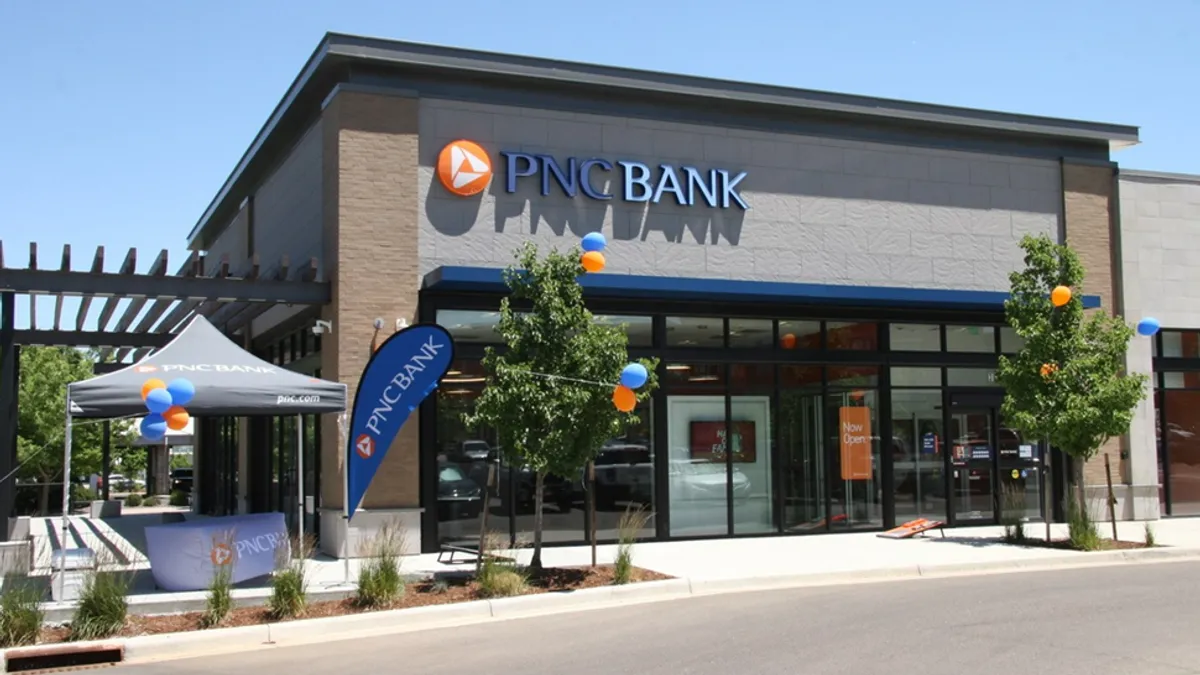
PNC’s emphasis on hospitality and elevating its service level in branches has bolstered customer experience scores in recent months. The super-regional is hoping to do the same on the digital side with recent and forthcoming upgrades.
The Pittsburgh-based bank has spent the past couple of years replatforming its digital interface for customers, and last month completed the migration of customers onto that new online banking platform, said Alex Overstrom, the bank’s head of retail banking.
That upgrade allows the bank to more quickly introduce new capabilities, such as digital direct deposit switching and instant debit card issuance within PNC’s mobile app – features that aim to build primacy with clients, Overstrom said during a recent interview.

PNC CEO Bill Demchak has mentioned the bank scores well with customers on its branch experience, but is “no better than average” with online and mobile banking, and needs to do better.
“It’ll be a better experience for our customers, in the sense that it’s more easily navigable, there’s more self-service,” Demchak said of forthcoming upgrades during a January earnings call. “But the biggest thing that it does for us, is it allows us to change and introduce products on the fly.”
What used to be a six-month process to update something within its online banking platform, “we can literally do overnight” with the new system, Demchak said at the time.
The lender is also working to launch a new mobile app in the first half of next year. PNC is leveraging agentic technology to do that, employing a series of orchestrated AI agents to build it more quickly, Overstrom said.
The app will feature a new user interface and navigation framework, and “a whole bunch of incremental functionality to what our current app has today.”
PNC is about 40% to 50% complete with that project, Overstrom said, with the goal being to roll out the mobile app ahead of the FirstBank conversion; systems integration is projected to take place in June 2026.
“If we can get our digital experiences to the same quality as our human experiences, we'll be in great shape,” Overstrom said.
The bank declined to say how much it’s invested in those tech upgrades.
Overstrom pointed to the importance of marrying the digital with the physical and the “halo effect” of branches on digital sales.
In markets where PNC has a heavy branch presence, the lender’s digital sales are six times what they are in markets where it doesn’t have branches, he said. “People want to know that they’ve got a bank around the corner,” even if it’s “a person that's going to interact 99.9% digitally,” he said.
Overstrom said it’s been a record year for demand deposit account sales in branches; for the third quarter, the bank reported consumer DDAs grew 2% year over year, with the Southwest seeing 6% growth.
PNC has also made a concerted effort this year to enroll customers in online banking and show them how to use the bank’s app while they’re in the branch opening an account.
One year ago, of the consumers that opened a new deposit account in the branch, 45% were digitally active that same day. As of November, that’s 59%, Overstrom said. Overall, about 77% of clients are digitally active across the bank’s consumer business.
Last month, PNC announced it was bolstering its branch expansion plans, pledging to open 300 new locations by 2030. The lender, which has said it will spend about $2 billion on the branch investments, plans to open 35 new branches in Nashville, Tennessee, and 25 in Chicago. The bank is targeting about a 7% branch share in its markets.
Chicago, where PNC has about 115 branches, is a market where PNC lacks the density it desires.
“If you looked at a map of our network, there were some holes around the city that we thought we could fill,” Overstrom said, and “to drive that sense of density, that sense of ubiquity, that sense of convenience, and really own the Chicago market.”
Although the city doesn’t have the same growth profile as some of the Southeast or Southwest markets on which PNC is focused, Overstrom noted many suburbs have seen attractive growth, “and it’s quite affluent as well.”
Some new branches will be located downtown, while others will be in surrounding areas, in Cook, McHenry or Will counties, Overstrom said.
Some other banks have also highlighted expansion efforts in Chicago, including U.S. Bank with business banking teams.
“It’s much less sort of competitor-driven, and much more our own strategy,” Overstrom said of the bank’s plans in the Windy City.
Notably, PNC has said it will hire about 2,000 people as part of its new branch push. But that’s roughly equal to the number of employees it’s cut the past couple of years through automation.
“The other thing where we've seen just a tremendous amount of cost takeout’s been sort of our operational and middle office areas,” Overstrom said at the BancAnalysts Association of Boston conference in early November. “I think we've taken out probably more than 2,000 people over the last couple of years in those areas, just as we've begun to automate more processes and just drive more efficiency through that.”
Additionally, the lender began optimizing its branch network in 2022, closing grocery store branches and consolidating in areas where some branches were too close to each other. Those efforts are largely finished, Overstrom said, projecting the bank will close about 30 branches this year.