Dive Brief:
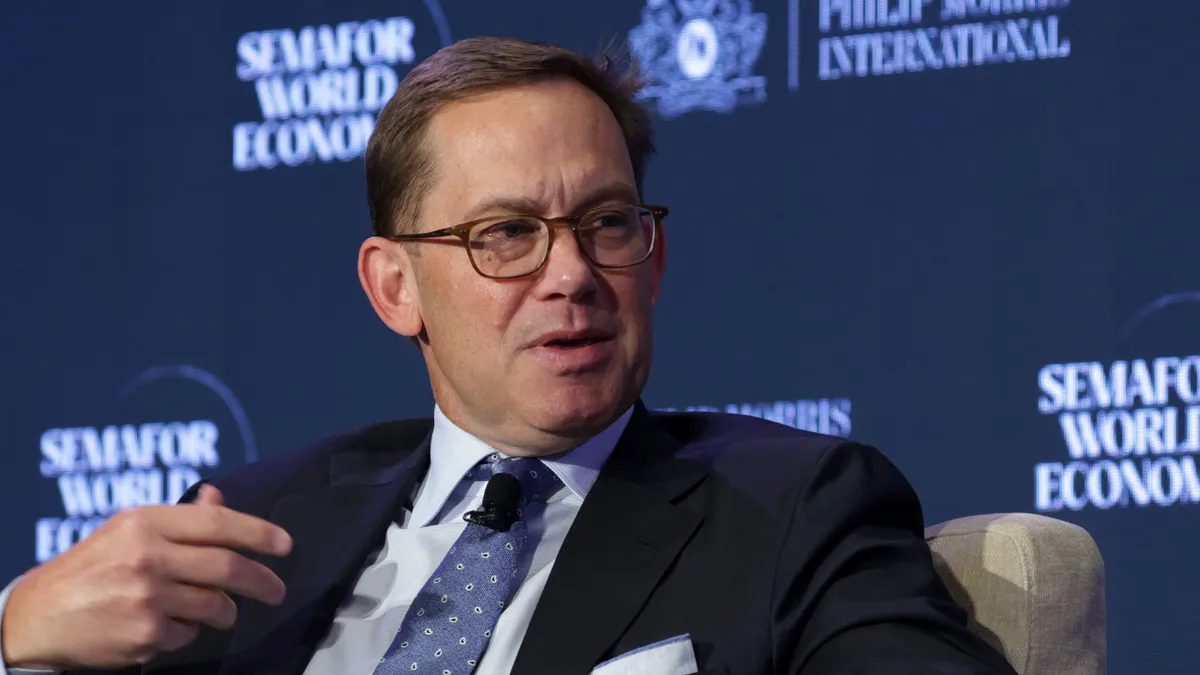
- For fintech Chime to achieve its long-term vision, CEO Chris Britt said Monday “it’s more of a when, not if” that the company will seek a bank charter.
- “It’s, to some degree, an inevitability that we’ll become a bank; the question is just, when?” Britt said during an appearance at a JPMorgan Chase investor conference.
- “Every year, we take a step back and evaluate, is now the time?” Britt said. Regulators have demonstrated an openness to new charter applications, so it’s something “we’ll be looking at again this year and figuring out what the best path is,” he said.
Dive Insight:
Chime is satisfied with its bank partners, said Britt, the company’s co-founder. The fintech works with Stride Bank and The Bancorp Bank, so it can offer customers Federal Deposit Insurance Corp.-insured banking services.
Chime has about 10.2 million monthly active members, who Britt said Monday are “not the unbanked.” Chime customers come to the company from big banks such as JPMorgan, Bank of America and Wells Fargo – “relationships that maybe they’re not happy with because they feel like they’re getting fee-ed to death,” he said.
Chime also draws customers seeking access to short-term liquidity, the desire to build credit, and those “making progress in their financial lives and feeling like they’ve got someone on their side that really wants to help them get ahead,” Britt said.
The company’s aim to become the top provider of banking and financial services to “everyday Americans” boosts the likelihood of the charter pursuit, he said. Chime refers to that group as the 200 million people making up to $100,000 annually.
The fintech sees itself competing largely with incumbent banks, since that’s where most primary account and direct deposit relationships reside, Britt said.
Chime operates its own tech stack and forgoes a branch footprint, allowing it to offer lower-cost products than rivals, Britt said. And big banks are more focused on large corporate clients and large “whales” on the consumer side, he asserted.
“If you’re someone that makes $50,000, $60,000, $70,000 a year, you’re probably not that well served by the incumbent banks,” Britt said.
The company is seeing the fastest growth among customers making more than $75,000 annually. With newer offerings geared toward mass-affluent consumers like Chime Prime, “we’re not really competing with the [Chase] Sapphire card, or the Robinhood Gold Card,” Britt said. “We’re competing with checking accounts, and the checking account offerings that the incumbent banks have are just not that great. They’re not rewarding.”
Asked about competition from abroad, Britt said international players’ products are “a little bit different than what might resonate here in the United States.”
A number of companies are capitalizing on regulators’ receptiveness to fintechs obtaining bank charters. In March, U.K. neobank Revolut applied for a charter from the Office of the Comptroller of the Currency. In January, Dutch neobank Bunq reapplied for an OCC charter, and Brazilian digital challenger Nubank received conditional OCC approval for a charter.
Last month, Wells Fargo CEO Charlie Scharf was also asked about the threat Revolut poses. He said his $2.1 trillion-asset bank doesn’t write off fintech competition.
Over the past 15 years, fintechs have “made it very clear to people who run banks that the moats that have existed that have allowed you to move slowly are no longer going to protect you,” Scharf said last month during an interview at The Economic Club of Washington, D.C.
That puts pressure on the bank to deliver, but Wells maintains a strong position, Scharf said.
“When you're at a big company, you sit and look at small companies and say, ‘Oh my God, look how quick they can move, the great products, and they understand the customer,’” Scharf said. “All those things are true. And then when you go to one of those companies, you look at a company like us and say, ‘They have 70 million customers. Wow.’”