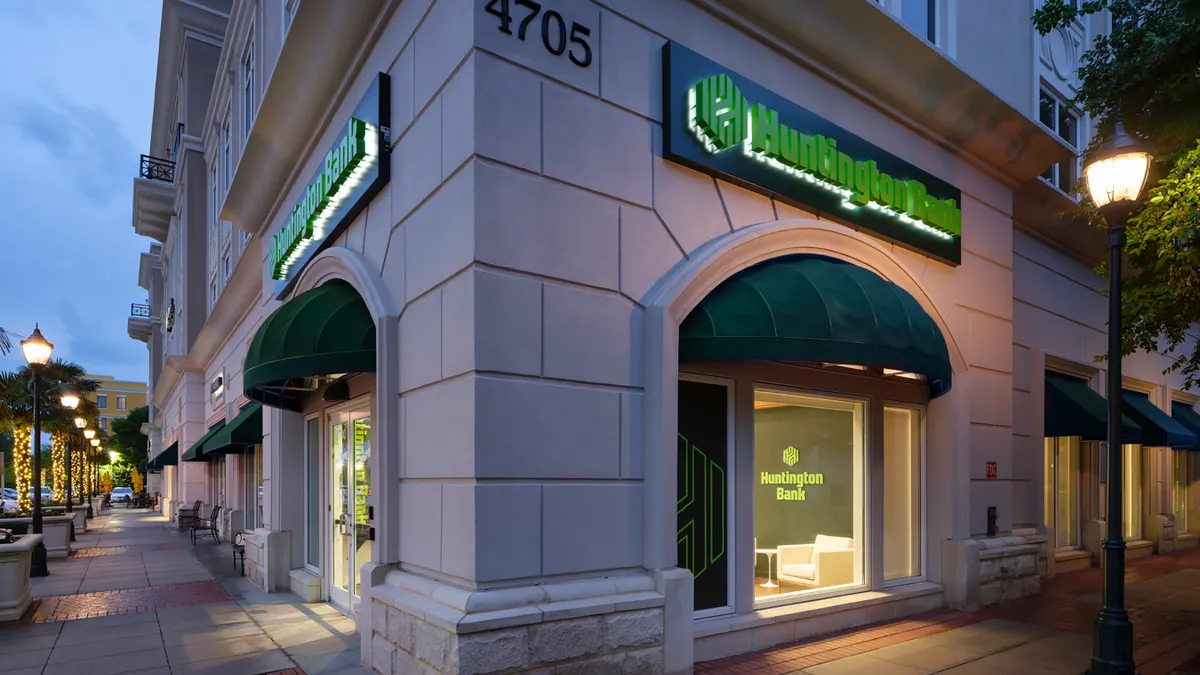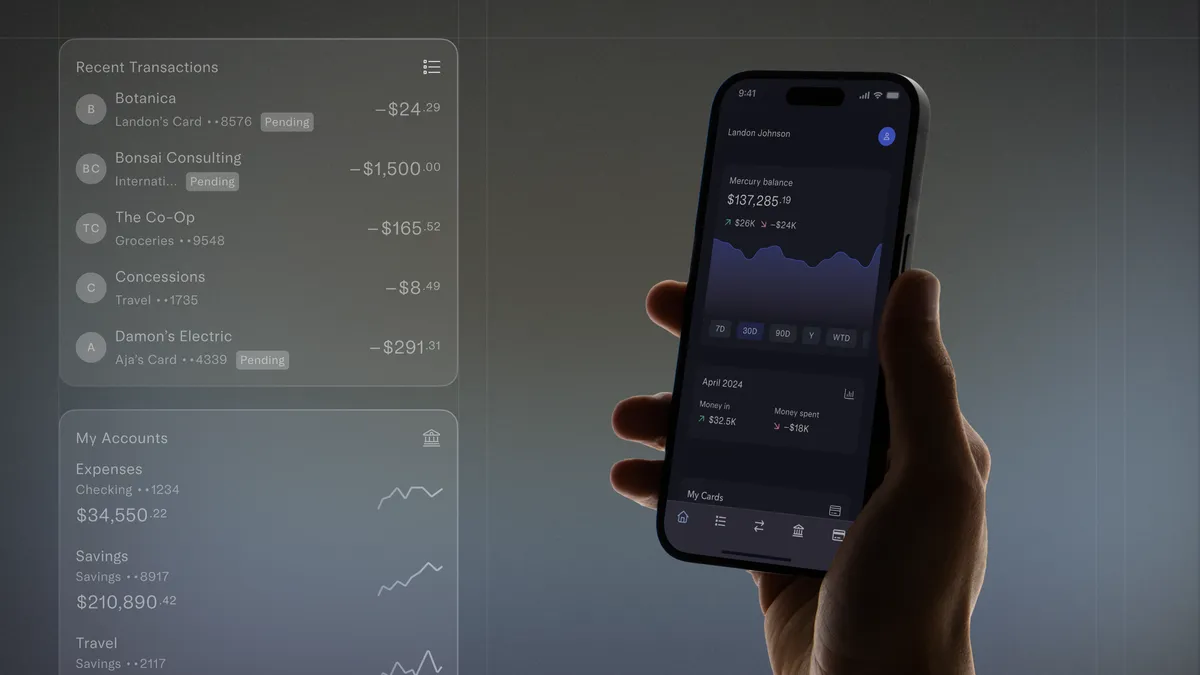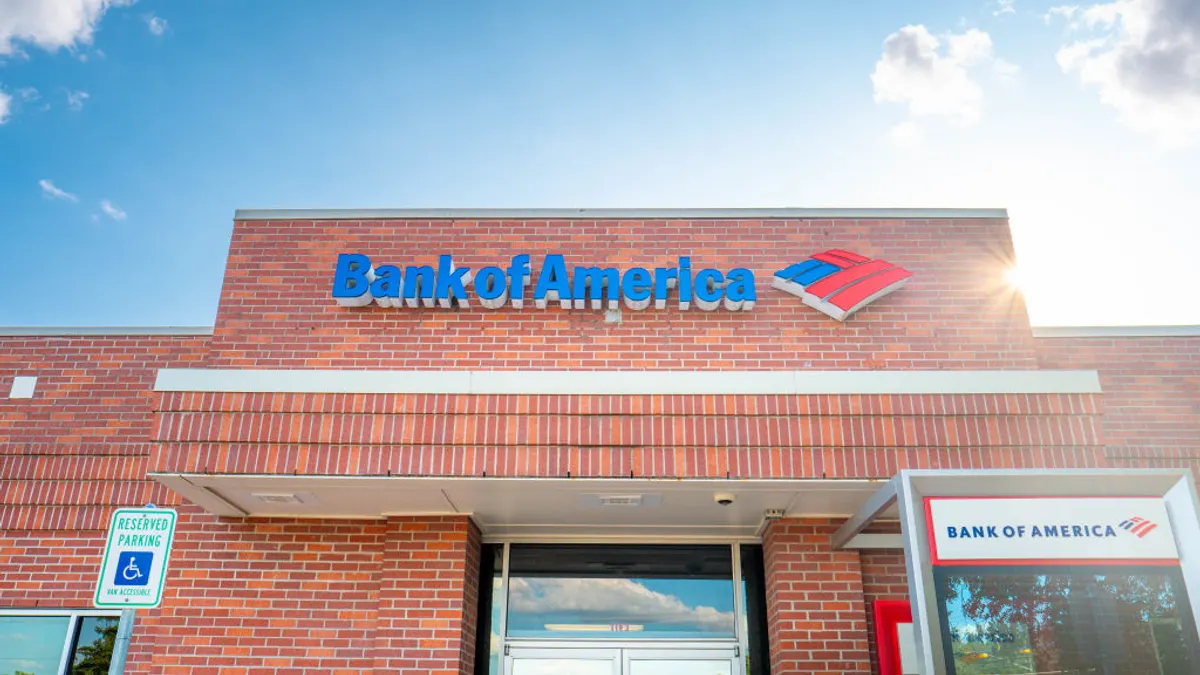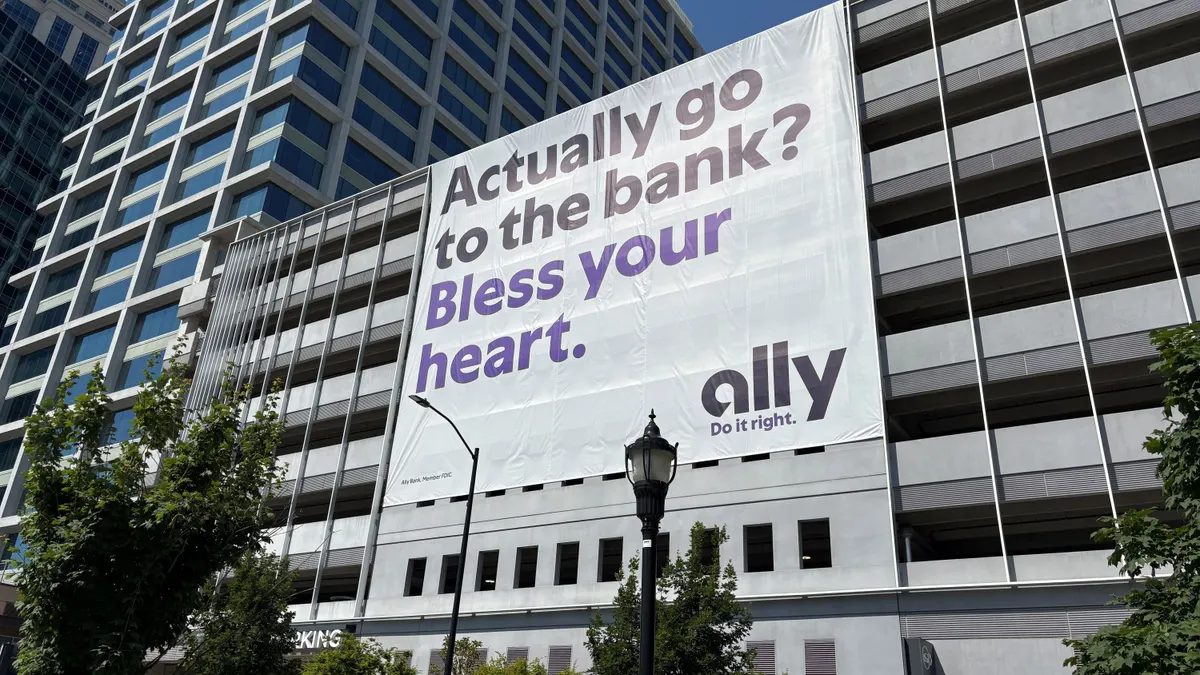
Playing up its digital bank identity, Ally’s new marketing campaign is taking jabs at bigger banks’ efforts to open or renovate branches across the country.
A billboard covering the side of the Ally building’s parking garage in Charlotte, North Carolina, reads “Actually go to the bank? Bless your heart,” invoking the multipurpose Southern phrase.
Bridget Sponsky, executive director of brand, sponsorship and creative marketing at Ally, didn’t say whether the advertisement was directed at competitor banks or bank customers. She said the digital bank is “an ally for everybody,” but is “redefining” its target audience as digital natives, “specifically Gen Z and millennials.”
“It feels like it really resonates contextually with consumers who are used to doing their banking from their phone,” she said in a recent interview.
For $197.3 billion-asset Ally, the campaign is “about competing for attention in a category that’s just getting more and more crowded,” she said.
When consumers have more choices than ever, the bank’s refreshed identity and messaging helps the brand “be unmistakable” and “distinctive,” Sponsky said.
Another Ally billboard, in New York City, speaks to both rival banks and consumers, reading “Cool branch, bro. No branches means more money for you.”
A third reads, “Laughing all the way to the bank (which is on your phone) so it’s a pretty short laugh. Ha.”
Ally’s marketing has already stirred up some competitive conversation. In a LinkedIn post, an employee of Regions Bank – which occupies office space down the street from Ally in Charlotte – said the “Bless your heart” sign can “come across as dismissive toward people who still value walking into a branch and speaking with a banker face-to-face.”
Sponsky contends “you don’t need to have a branch to have a banking partner.”
“Just because we don't have a branch doesn't mean that we aren't providing that one-to-one, thoughtful and intentional customer service,” she said.
The new “Life Today” brand platform and marketing campaign – developed with agency Anomaly LA and launched Thursday – also signals the lender’s intentions to pursue younger customers.
Those consumers in particular don’t have a “linear money journey,” Sponsky said. “Life and money is just really messy.”
The brand refresh and campaign are “designed to make Ally recognized beyond just a name, but a true financial ally that consumers understand will be there across their entire everyday financial lives,” Sponsky said.
The goal: “Expanding Ally's role in people's financial lives to become their primary bank for saving and spending,” she said.
Not only are Gen Z and millennials more likely to already be digital bank customers, they’re more open to switching their primary bank accounts, and specifically switching to a digital bank, the lender found through consumer research.
Those generations also put more priority on the digital experience when considering a new primary bank, Ally said. Primary drivers for consideration of new accounts are trust, value and convenience across all demographics, according to the bank’s findings.
In the first quarter, Ally’s retail deposits rose $63 million year over year, to $146 billion. The bank added 74,000 net new deposit customers in the quarter, totaling 3.5 million.
The Detroit-based bank declined to specify how many of its retail customers are Gen Z or millennial, or any specific goals related to increases for those demographics, but the first-quarter earnings release notes “millennials and younger customers continue to comprise the largest generation segment of new customers.”
In the last three months, 43% of all new checking accounts were opened by millennial customers, and another 31% by Gen Z, according to JD Power data, said Jennifer White, a managing director in financial services at the firm. For savings accounts, those figures are 37% and 32%, respectively. More than half of the accounts are being opened at national banks or neobanks, she said.
Ally declined to share how much it has spent on the brand refresh and campaign. A spokesperson said the lender is “making a meaningful investment because this platform is central to our future,” and it’s “designed to scale across channels and over time.”
Sponsky said Ally already has the right product set to serve Gen Z and millennials, with buckets that help customers track their savings goals, and the ability to round up when spending to boost savings, and the marketing effort seeks to draw more attention to that.
As part of its focus on partnerships, Ally plans to do more work with influencers – specifically female athletes – to bolster trust and engagement, Sponsky said. Ally recently reached its goal of equally splitting its advertisement spending on women’s and men’s sports media.
Women athletes are “seen as very trusting, they’re credible, they’re seen as role models, which is exactly what we want our bank to be,” she said.
With banks, fintechs and providers facilitating money transfers, the financial services landscape has become “extremely competitive,” Sponsky said. And financial services spending on sponsorships has grown, including on stadium rights and in women’s sports, she noted.
“It’s competing for consumer eyeballs across the board,” she said.
That requires Ally to be more creative and thoughtful “about how we ensure that our brand is modernized and it's contextually relevant to the target audience that we're going after,” Sponsky said.