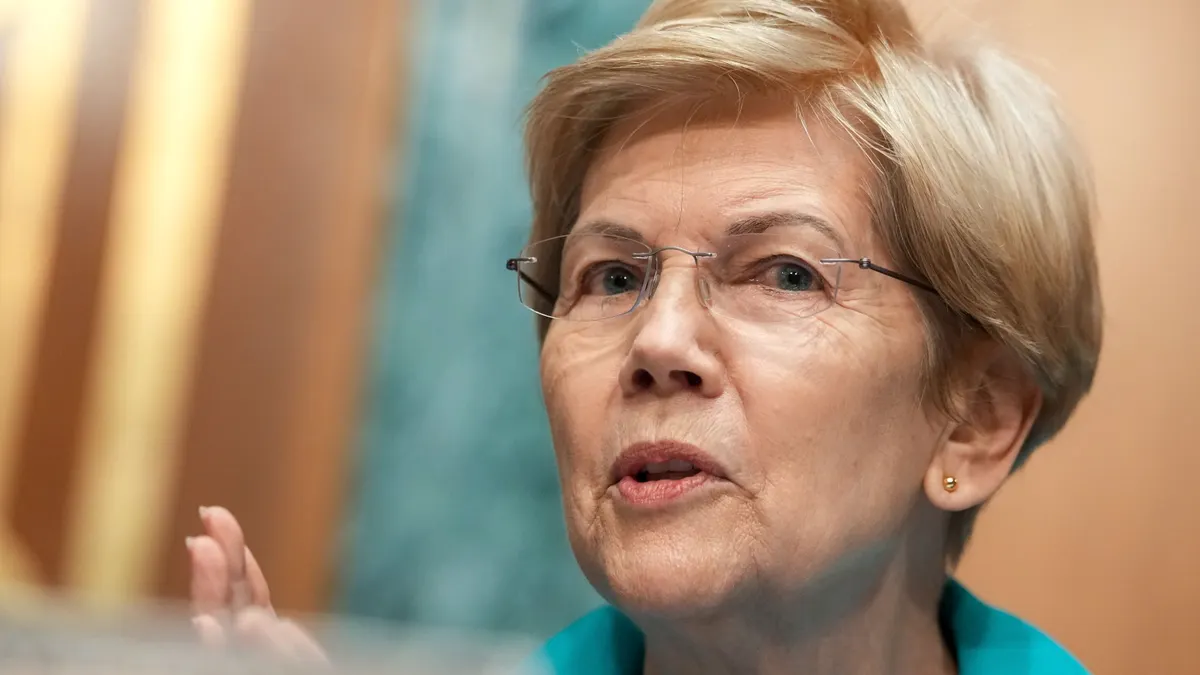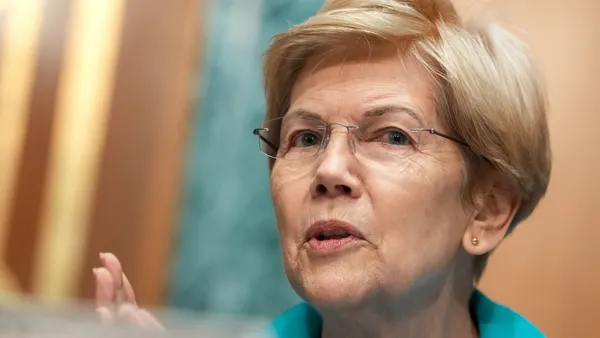
Sen. Elizabeth Warren, D-MA, demanded Wednesday that three regulators revoke their approval of an exemption that allows Morgan Stanley to incorporate its German investment bank into its holding company.
However, the Federal Reserve, Office of the Comptroller of the Currency and Federal Deposit Insurance Corp. “provided no analysis or evidence to support the conclusion that the exemption is in the public interest and is consistent” with the intent of Section 23A of the Federal Reserve Act, Warren wrote in a letter to the regulators.
Congress amended the Federal Reserve Act in 1933 to prevent banks from using their access to a federal safety net to subsidize the nonbank activities of affiliates, Warren argued.
Morgan Stanley’s German unit is primarily engaged in “sales and trading of fixed income and equity products, investment banking, capital markets and research,” Warren wrote, citing a Fed employee’s description of the business.
“Morgan Stanley has not been shy about the intent of the transaction,” Warren said. “It is engaging in this restructuring to fund the affiliate’s existing business with cheaper federally insured deposits, thereby ‘cost saving’ and improving ‘profitability.’”
But “‘profitability,’ ‘efficiency,’ and ‘cost savings’ are not statutorily permitted justifications” for the exemption,” Warren wrote Wednesday. “Nor is ‘the provision of products and services to European customers.’”
The exemption “diverts deposits away from domestic lending for businesses and households in the United States, and needlessly exposes our country’s banking system to risks in European financial markets,” Warren argued.
She asked the Fed and OCC to explain, by June 3, why they believe it’s in the public interest to let Morgan Stanley boost its profitability while increasing risk to the U.S. banking system – and further asked whether U.S. customers will receive improved banking products and services through the exemption.
The gravity of the exemption request, Warren argued, is “unprecedented outside of a financial crisis.”
The senator then noted two instances from the past two decades, in which restructurings such as the one sought by Morgan Stanley contributed to heavy losses. Citi received a Section 23A waiver in 2006 to move subprime mortgages assets from an affiliate into its insured bank, Warren asserted. In retrospect, the Comptroller of the Currency at the time “admitted that this corporate restructuring increased Citibank’s losses during the [2007-08] financial crisis,” she said.
Warren also cited the 2012 “London Whale” scandal, in which JPMorgan Chase lost more than $6 billion on credit derivatives trades booked in a London subsidiary. The incident spurred regulators including the Fed, OCC and the Commodity Futures Trading Commission, to issue more than $1 billion in fines against the bank, she said.
Warren chastised regulators’ omission of the Citi and JPMorgan cases from their evaluation of Morgan Stanley’s request.
“Confusingly, in her voting statement to justify the exemption, [Fed] Vice Chair [for Supervision Michelle] Bowman asserted that ‘for as long as these foreign activities have been permitted, no U.S. bank has suffered material financial losses arising out of these overseas activities,’” Warren wrote, adding that Bowman’s statement is “directly and obviously contradicted by recent history.”
Warren further needled Bowman: “How does the existence of the 2012 ‘London Whale’ scandal, as well as the losses generated by U.S. banks’ foreign activities during the 2008 financial crisis, affect the accuracy of this statement?”
Morgan Stanley’s exemption fails in two ways, Warren argued. For one, restructuring doesn’t appear to be in the public interest, she said.
“The banking agencies have previously defined the public interest as ‘assuring the safety and soundness of the banks, protecting the deposit insurance fund, and limiting the extension of the federal safety net,’” she said.
Second, she added, by extending the federal safety net to a nonbank affiliate, “the transaction is diametrically opposed to the purpose of Section 23A.”
Warren asked the Fed and OCC to provide copies of any Section 23A waiver applications received since the start of the second Trump administration. Further, she asked the FDIC to give her a copy of its nonobjection to the exemption and any analysis of risk posed to the deposit insurance fund.
“If the agencies refuse to reverse this unlawful exemption, future regulators would be responsible for correcting this error and requiring divestiture of the transferred assets and liabilities out of the bank,” Warren warned.