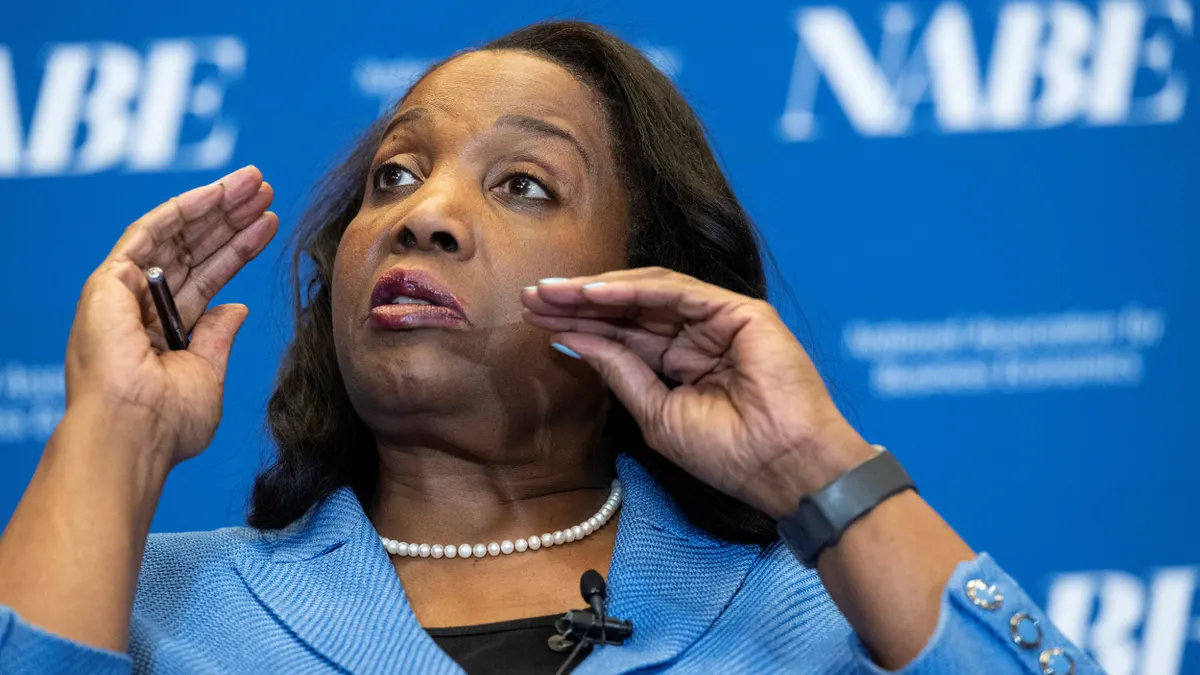
LAS VEGAS – There’s some truth to the perception that regulators can be slow to respond to innovation and resistant to updating regulations to accommodate new technologies in the financial sector, a former federal official said Sunday at the Money20/20 conference.
But industry often doesn’t acknowledge its role in driving understanding, said Carole House, founder and CEO of Penumbra Strategies, a technology and national security advisory firm, during a session at the event in Las Vegas.
And collaboration is crucial to moving faster to combat threats to the financial system, she said.
“Both sides need to understand each other and come at each other with greater empathy and timeliness on collaboration,” House said Sunday. “Public-private really sits at the heart of our ability to address these threats.”
House, a Treasury Department alum who’s also served on the National Security Council, testified during a House Financial Services subcommittee hearing in May related to modernizing the Bank Secrecy Act for 21st-century financial crime.
Amid a confluence of burgeoning technologies including blockchain and agentic commerce, regulators and industry players are underestimating “the need for true, timely action,” she said Sunday.
With increasingly sophisticated technology fueling automation and decentralization, “we need to figure out how to keep pace and modernize the illicit finance framework to keep pace with that,” House said.
“Because whether it's combating adversarial capital making its way into our defense supply chains, or pig-butchering networks that are leveraging Chinese money laundering organizations and human trafficking fueled scam centers in East Asia, all of these are issues that are affecting us and humanity,” she said.
She advocated for more timely enforcement and clarity of regulatory frameworks and application, as well as information sharing.
“We need to drive some of the lessons that we've learned in cyber to share instantaneously a lot of information, point to point, that we've not done in finance,” House said.
That involves enforcement evolution. When regulators create tech-neutral regulatory frameworks, those will capture innovations meeting certain activity-based functions, she said. But policy that’s not implemented becomes “feckless,” she added.
“We weren't scaling enforcement,” House said. “There are places where regulators weren't thinking about how to adapt the whole framework to drive more timely compliance across the industry, including with many entities that want to operate within the regulatory perimeter and want to partner to go find bad guys.”
The other side of that coin, though, means “early and often enforcement,” she said. “I think enforcement should be iterative and sector-shaping, not sector-breaking.”
New technologies can reinforce each other’s best and worst traits; the latter include trustworthiness and hallucination concerns with AI, and accountability problems with greater decentralization inside blockchain, she said.
The potential for those to scale simultaneously can create an “inflection point” that House said industry and regulators “need to be looking at very pointedly.”
At the current moment, the regulatory “cuffs kind of coming off” of traditional finance, enabling them to play in some emerging technologies, is notable, she said. Big banks bring a lot of operational risk and cybersecurity knowledge, and more work is needed in those areas, she added.
In the past, “it was hard getting fraud to be cared about as a national security issue, and as the trillion-dollar shadow war that is now being waged here,” House said.
“It's taken this level of scale and the nexus with Chinese money laundering organizations and human trafficking and the fact that we have a generation's worth of wealth that is being exfiltrated” to elevate the fraud issue “to the status that it should be,” she said.
Investments in digital identity are essential to address it, House said. That’s something two lawmakers have also underscored, putting forth legislation that would establish grant programs for states to create digital versions of driver’s licenses and guard against risks like AI deepfakes.
Digital identity has become “a political lightning rod,” House said, but “the fact that we have not invested in scaling meaningful digital identity infrastructure has meant that we were not ready for the authenticity crisis moment that is now being scaled massively because of these amazing AI solutions.”
House said she’s part of an international fraud task force that has U.S. and U.K. Treasury representatives as co-chairs, as well as members of the technology, telecommunications and finance industries, who are mulling how to fight the issue.