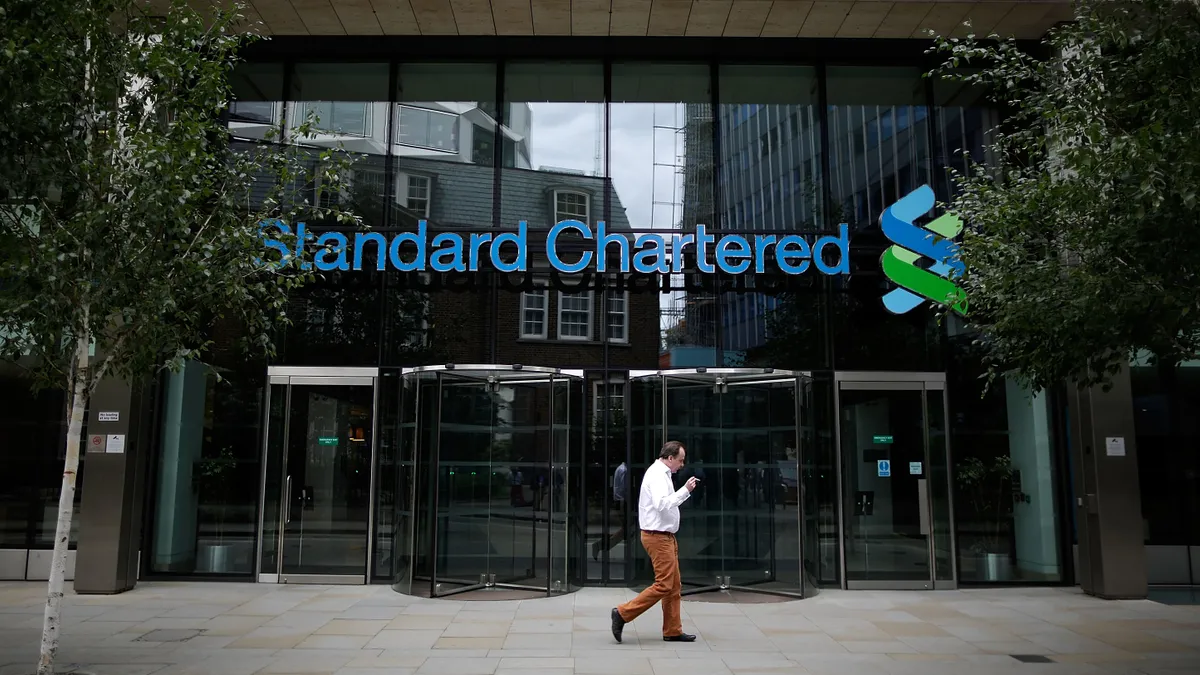
Standard Chartered plans to eliminate nearly 8,000 jobs over the next four years in a further pivot toward artificial intelligence, the bank said Tuesday.
“It’s not cost cutting; it’s replacing, in some cases, lower-value human capital with the financial capital and the investment capital we’re putting in,” CEO Bill Winters said during an investor day in Hong Kong. “We don’t have job losses, but we do have job role reductions in favor of the machines, and that will accelerate as we go forward into AI.”
Among a set of revised targets StanChart unveiled Tuesday, the bank aims to raise income per employee by roughly 20% by 2028. As part of that effort, the bank wants to reduce its “corporate functions roles” by more than 15% by 2030, it said.
Corporate functions roles include human resources, risk management and regulatory compliance, according to the bank’s website. StanChart’s back-office centers in Chennai and Bengaluru, India; Tianjin, China; Kuala Lumpur, Malaysia; and Warsaw, Poland, will be most affected, Winters said.
However, impacted employees will receive “good clear notice” ahead of time, he added.
“The people that want to reskill, that want to carry on, we're giving every opportunity to reposition," Winters said.
The bank counted 52,271 employees in back-office operations as of December. That puts the expected job-reduction figure at 7,840.
StanChart is hardly the first bank to foretell job reductions in favor of AI. Italy’s biggest lender, Intesa Sanpaolo, said in 2024 it would cut 9,000 jobs by 2027 – and hire 3,500 “young people” to support greater use of AI and further digitalization.
Japanese banking giant Mizuho announced in February it plans to replace roughly 5,000 administrative jobs with AI over the next 10 years.
American banks, by comparison, have expressed enthusiasm over AI’s potential but have generally been cautious about tying a firm number of job reductions to the burgeoning technology.
Goldman Sachs CEO David Solomon, speaking at an event last October, said his bank is “much more productive on a revenue-per-employee basis today than it’s ever been, and it will be much more productive as we go forward, but that doesn’t mean we will have less people.”
“It means we have an opportunity to have more valuable people doing more valuable things to serve our clients and grow our franchise,” Solomon said.
That philosophy has extended to at least one U.S-based fintech, too.
“We are not planning AI-related layoffs, full stop,” Affirm CEO Max Levchin said this month during a quarterly earnings call.
Rather, AI is “just a thing we’re going to keep using to ship more,” he said. “These tools are giving us rocket boosters, wings, whatever metaphor you want, and we’re very happy for it.”
Speaking to the World Economic Forum in Davos, Switzerland, in January, JPMorgan Chase CEO Jamie Dimon said he expects AI will result in the top U.S. bank employing fewer people in five years.
However, he warned against implementing job automation too quickly.
“You can’t lay off 2 million truckers tomorrow,” Dimon said. “If it goes too fast for society, that’s where government and business in a collaborative way should step in together and come up with a way to retrain people.”
The embrace of AI is just one facet to StanChart’s revamped targets. The bank aims to boost its return on tangible equity to 15% by 2028 – and 18% by 2030. It hovered near 12% in 2025.
The bank also wants to increase its common equity tier 1 capital to between 13% and 14%.
And it wants to push up, to 2028, the timeline by which it captures $200 billion in net new money from wealth and retail banking.
“We will invest disproportionately in this business,” StanChart noted.
The London-based bank has become the third-largest and fastest-growing wealth manager in Asia, it said.
The strategy refresh comes as StanChart wraps up its “Fit for Growth” initiative, which delivered $1.5 billion in annualized savings ahead of schedule, according to the Financial Times.
Tuesday’s investor day also falls less than 48 hours after the bank made two high-profile leadership changes. StanChart on Sunday named its head of investor relations, Manus Costello, as its next CFO. It also appointed Tanuj Kapilashrami as its chief operating officer.
Costello replaces Diego De Giorgi, who left the bank in February and was labeled a “driving force” of the Fit for Growth campaign. De Giorgi had been seen as a potential successor to Winters, the longest-serving CEO in U.K. banking, at 11 years.
The strategic pivot arguably cements Winters in the CEO role. The executive said Tuesday he will be around for the next few years to see the refresh through.
“We are investing in the capabilities that will compound our competitive advantages and drive sustainable growth and higher quality returns over time, with clear targets in place,” Winters said Tuesday.
StanChart’s stock price is up 67.4% over the past year, according to Yahoo Finance.