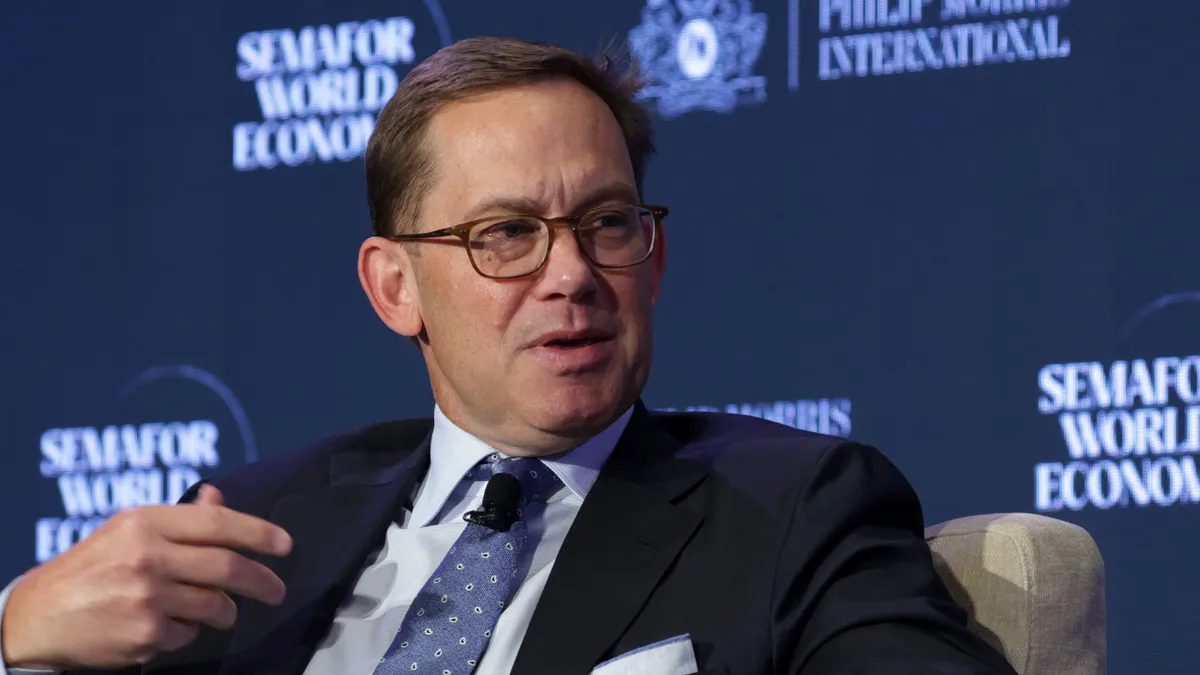
Truist CEO Bill Rogers defended the super-regional bank’s game plan Friday in response to analyst questions related to the bank’s M&A appetite, succession plan and growth outlook.
Charlotte, North Carolina-based Truist and Pittsburgh-based PNC were both mentioned as potential targets in a recent Bloomberg report that said Citi is considering a regional bank acquisition. Citi CEO Jane Fraser on Tuesday firmly rejected the idea that the lender is considering a bank deal.
“We are only interested in and focused on organic growth,” Fraser said during the bank’s first-quarter earnings call. “Period, end of story. For the whole firm.”
Notably, during PNC’s first-quarter earnings call Wednesday, executives were asked about M&A generally – PNC recently acquired Colorado-based FirstBank – but the specific possibility of being acquired by a larger lender was not broached by analysts.
During Truist’s first-quarter earnings call Friday, UBS analyst Erika Najarian noted the mention of Truist in the Bloomberg report and asked for Rogers’ thoughts.
“Clearly, you have a view of your future that's bright,” she said.
The bank set a new 16% to 18% long-term return on tangible common equity target, after nudging that profitability metric to 13.8% in the first quarter.
“At the same time, your market cap to core deposits is quite low, relative to your peers,” she said.
She also mentioned that Truist’s board includes “some heavyweight financial institution veterans.”
Rogers balked at speculating on the “rumor” – “which, by the way, has been refuted, I think, pretty solidly, by the person identified in that,” he said, seemingly referring to Fraser.
“We feel great about our business, and we feel great about the trajectory that we're establishing,” Rogers said.
The $544 billion-asset bank’s plan to bolster profits over an extended period of time “provides an advantaged return to our shareholders, and that’s always going to be the goal,” he said. “That's the 100% focus of our board, myself and our team.”
Truist’s first-quarter revenue dropped 5% to $5.15 billion, although the bank’s net income rose 17%, to $1.4 billion, according to an earnings release.
Wells Fargo Securities analyst Mike Mayo directly asked under what conditions Truist would consider another merger of equals, selling to another bank or buying another bank.
“This topic does come up, not just in the press, but with investors, as you know,” Mayo told Rogers. “It seems like you have a game plan. Having said that, the question does come up.”
“We've been really clear on the M&A front,” Rogers replied. “I don't know how to be more clear, that that's just not a priority for us. So, I mean, I'll just say it one more time.”
First-quarter results offer “more evidence of the fact that we're executing” on strategic priorities, Rogers said.
KBW analyst Chris McGratty expected the answer Rogers gave Friday.
“Truist has been very consistent; they’re not doing bank deals,” McGratty said after the earnings call. “Sometimes these type of questions get a little bit more airtime than the companies probably want them to.”
During the call, Mayo also asked about Rogers’ timeline as CEO. Rogers didn’t answer directly but highlighted the bank’s strengths including what he called a “strong leadership team.”
“I've got a great job leading a great purpose-led company,” Rogers said. “Just be confident that our board has a strong succession process, and they can apply that against this incredible framework.”
Bank of America Securities analyst Ebrahim Poonawala called out the bank’s 4% revenue growth projection for the year.
“You’ve got the scale, you've got all these businesses – shouldn't you be doing better in an environment which seems generally constructive?” Poonawala asked.
Rogers pointed to building momentum. “We're hitting on more cylinders, so that growth and revenue continues to increase,” he said.
An expected impact to net interest income affected the full-year revenue projection, he noted, “but if you look at the momentum in terms of new clients, the activity, the fee businesses … I think we'll continue to sustainably build that business, and sustainably build it with a more positive and continued operating leverage.”
That gave the bank the confidence in setting that long-term ROTCE target, he added.
In consumer and business banking, Truist reported 1% deposit growth year over year, to $213 billion, according to a first-quarter earnings presentation. In wholesale banking, the bank’s deposits grew 2%, to $148 billion.
Pressed on deposit competition questions, executives repeatedly said it’s a competitive environment, given persistent yield-seeking behavior.
“That's where the pressure is really coming from, that drove our output a little lower,” CFO Mike Maguire said.
A higher-for-longer interest rate environment is a tough operating environment for deposits, Rogers said. That has the bank focused on lining up new clients and growing with them, which he said Truist is doing in both consumer and wholesale. The bank has also sought to deepen relationships with existing clients as part of its push to drive profit growth.
“While the profitability of those clients is less today, the fact that we're adding them is a good harbinger for profitability in the future,” Rogers said.
He also pointed to premier banking production jumping 20%, saying that’s an area Truist has put strategic focus on in recent quarters.