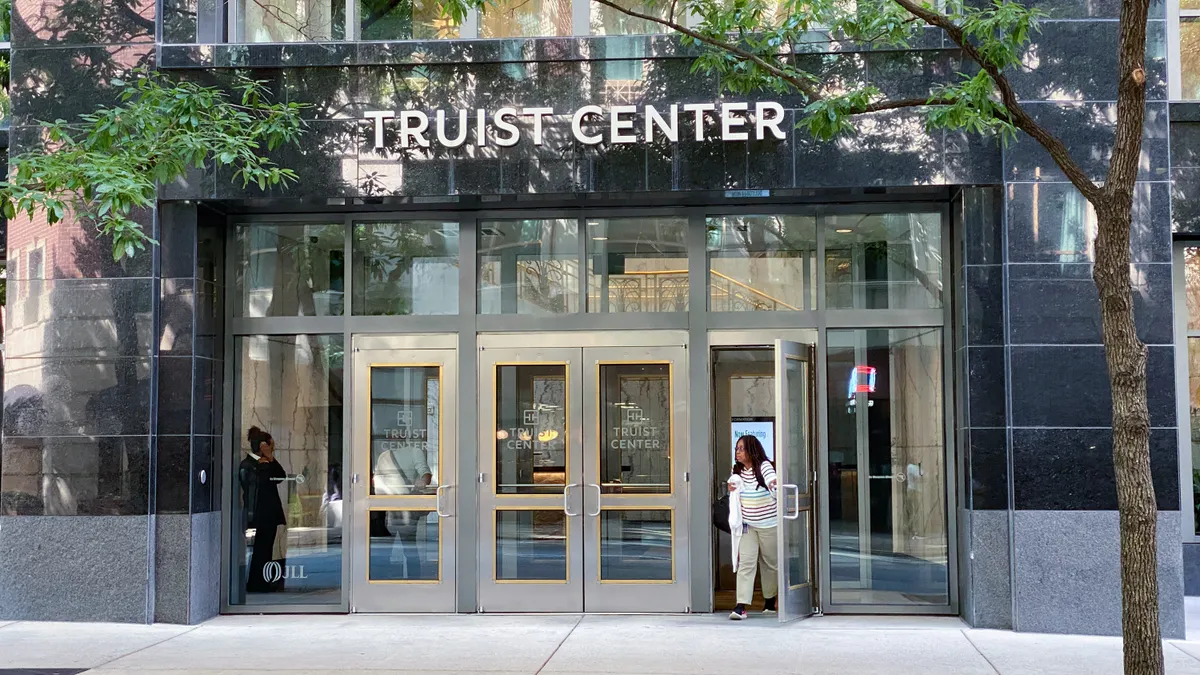
Truist has hired Fiserv’s chief executive, Mike Lyons, to be its next president and CEO, succeeding Bill Rogers, the bank said Monday.
Lyons, 55, starts as Truist’s CEO Sept. 1, the bank said in a news release. Rogers, who has been the Charlotte, North Carolina-based bank’s CEO since September 2021, will become executive chair on that date. Rogers is set to remain in that role until his retirement in April 2027.
“Through our succession planning process, it became clear that Mike is an action-oriented leader committed to high performance across the full range of our company operations and the right person to lead Truist's next chapter of growth,” Thomas Skains, Truist’s lead independent director, said in the release. “We are incredibly grateful for Bill's purpose-driven leadership as Truist's chief executive officer, and we look forward to his impactful contributions as executive chair.”
Rogers, 68, was also Truist’s president and chief operating officer from 2019 to 2021. He had been CEO of Atlanta-based SunTrust, which merged with Winston-Salem, North Carolina-based BB&T in 2019 to form Truist.
Following the merger of equals, Truist undertook a significant cost-cutting effort and sold its insurance business. Last year, analysts said the super-regional seemed to be turning the corner on growth.
Rogers fielded some tough questions during the $549 billion-asset bank’s first-quarter earnings call in April, when he was asked about succession plans at the lender, and reports that Truist might be bought by a larger bank.
Rogers balked at speculating on the latter, which he called a “rumor.”
“We feel great about our business, and we feel great about the trajectory that we’re establishing,” Rogers said.
As for succession, Rogers didn’t answer directly but highlighted the bank’s strengths, including what he called a “strong leadership team.”
“I’ve got a great job leading a great purpose-led company,” Rogers said. “Just be confident that our board has a strong succession process, and they can apply that against this incredible framework.”
On Monday, Rogers said Lyons will “move Truist forward with purpose and care, and a sense of urgency to realize our potential.”
“It has been the professional privilege of my lifetime to lead Truist and to work alongside truly extraordinary teammates,” Rogers said in the release. “We are proud and ready for this important next chapter in our story.”
Lyons joined payments giant Fiserv in January 2025, as former CEO Frank Bisignano accepted a Trump administration position, heading up the Social Security Administration.
Lyons officially became Fiserv CEO last May. Lyons has dubbed this a transition year for Fiserv, after he announced a “critical and necessary reset” for the company last October.
Prior to Fiserv, Lyons had been president of Pittsburgh-based PNC, where he spent about 13 years.
“Truist is an exceptional bank with a strong foundation, incredible teammates and an extraordinary culture,” Lyons said in the release. “I couldn't be more excited to join the bank as CEO to apply my leadership experience and vision to drive the next phase of Truist's growth, cementing its position as a bank of choice for clients and creating value in the communities we serve. I also want to express my gratitude to Bill for the company and culture he has built.”
‘Fresh perspective’
Analysts covering Truist dubbed Lyons “a welcome outsider” offering “a fresh perspective” at a time when the bank needs a boost.
Truist “has fallen short” since the 2019 merger, and Lyons seems to be “the right fit, even if a little late,” Wells Fargo analyst Mike Mayo wrote Monday.
Lyons, who was behind PNC’s successful expansion of its commercial lending and payments businesses, “can transcend the past issues and look at [Truist] as a white board whereby he can implement the disciplined execution and improved intensity that we most admired during his tenure at PNC,” Mayo said.
Lyons is viewed as a strong operator with banking and payments chops, and Truist investors seem pleased the bank has chosen an external successor, Truist Securities analyst Brian Finneran wrote Monday.
Lyons, who was “well respected and liked over his banking career,” can “reinvigorate” Truist, RBC analyst Gerard Cassidy wrote Monday. “We view the change in leadership favorably but recognize it will take some time for Lyons to put his imprint on the company.”
The CEO swap would also suggest Truist isn’t a near-term takeover target, UBS analyst Erika Najarian wrote Monday.
“While Mr. Lyons will be considered a welcome outsider, such a CEO change usually comes with cultural and [management] upheaval near-term,” she said.
$1.3 million salary
As Truist CEO, Lyons will receive a $1.3 million salary, and his prorated incentive award for this year will be no less than 325% of that, the bank said in a Securities and Exchange Commission filing Monday.
For this year, Lyons will receive a long-term incentive award worth $12 million, structured the same way as those for other senior executives: 40% performance share units, 35% restricted stock units and 25% in cash-based long-term incentive awards, the bank said.
He will also be eligible for a 2027 long-term incentive award with a targeted value of at least $12 million when such awards are granted to other senior executives, according to the filing.
To make up for compensation he’s leaving behind at Fiserv, Lyons will receive cash awards of $1 million after he starts and $1.7 million in 2027 when other senior executives receive annual bonuses. He will also receive three long-term incentive awards: restricted stock units worth $13.2 million vesting over three years; performance share units worth $15 million total, divided across three performance periods; and long-term incentive plans worth $9.3 million total, also segmented across three periods.
Rogers will receive his $1.35 million salary through the end of the year, and $1 million from Jan. 1, 2027, through his retirement date next year, according to the filing. He’s eligible for an annual incentive performance award for this year and a prorated award for 2027, which is set to be 350% of his salary.
If Rogers is still in his executive chair role when other senior executives receive 2027 long-term incentive awards, he will receive $8.5 million in performance stock units, provided he remains through the company’s shareholder meeting in 2027, according to the filing.
Lyons will relocate from New York City to Charlotte within a year of his start date.