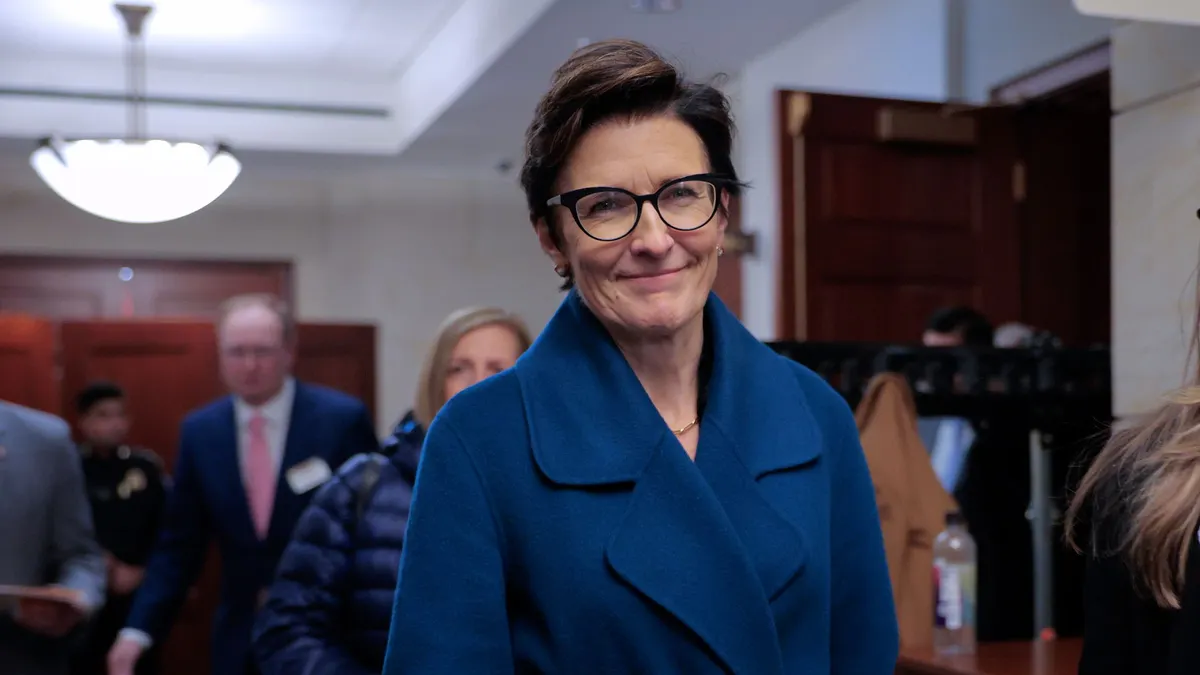
For years, Citi has referred to its turnaround under CEO Jane Fraser as capital-T Transformation.
But perhaps few paid attention to a “little t”: transition. Read: Where does a bank go after it takes a swing at wholesale change?
Citi since 2023 has been in rebuild mode – realigning its structure under five pillars, shedding layer upon layer of management (not to mention a projected 20,000 employees overall). But the “major actions” of the reorganization were declared done ahead of Citi’s services-focused investor day two years ago.
So, where to begin with the next one?
Citi, at its investor day Thursday, unveiled a multiyear $30 billion share buyback. That, however, was overshadowed by a new target for return on tangible common equity.
The bank said it wants to achieve an ROTCE of between 14% and 15% by 2031. That’s up from 8.8% in 2025 but far below the 20% that its rival, JPMorgan Chase, raked in last year. JPMorgan’s ROTCE stretched to 23% for the first quarter of 2026. By comparison, Goldman Sachs saw a 21.3% ROTCE in the first quarter, while Bank of America and Wells Fargo – arguably Citi’s closest competitors – saw 16% and 14.5%, respectively.
“This is a bank built both to grow and perform consistently, and that's what underpins the path to our target returns,” Fraser said Thursday.
Analysts with Royal Bank of Canada, in a note seen Thursday by Banking Dive, called the target “underwhelming in the near term.”
Citi’s near-term goal – for 2027 and 2028 – is to bring ROTCE to between 11% and 13%. To the RBC analysts’ point, though, Citi achieved 13.1% ROTCE in the quarter that ended in March.
Some of the bank’s investors sought a “more aspirational” target of 15% or more over the medium term, UBS analysts wrote in a note.
Tim Piechowski, portfolio manager at Alpine Capital Research, struck an optimistic tone, saying the “targets laid out today appear to be set up to be beat, rather than aspirational.”
“Citigroup is finally hitting its stride,” Piechowski told Bloomberg.
Relative peace, it seems, can be a tough transition for a bank that has experienced so much change in little time. Roughly a month after Fraser began her tenure as CEO, Citi announced it would exit 13 foreign retail-banking markets (and later, Mexico). Five years later, most of those assets are spun off, and the Banamex sale is in full swing.
The bank has also gradually revamped its tech after the infamous Revlon manual-transfer error spurred regulators to crack down on Citi’s risk management and data governance.
Citi said during its first-quarter earnings call last month that the bank is about 90% finished with back-office and regulatory reporting fixes connected to its long-running issues.
Still, arguably the most impressionable quote from Thursday’s investor day featured a heavy callback to the bank’s early-2020s woes.
“From the start, this was about more than just fixing the old Citi. It was about building the bank the next decade demands,” Fraser said. “We have rebuilt the engine, it is stronger, it is more durable and now we will show you what it can deliver.”
Thursday showed Citi is entering its little-t era after its capital-T Transformation. Time will tell whether the bank and its investors are comfortable with change on a small scale.