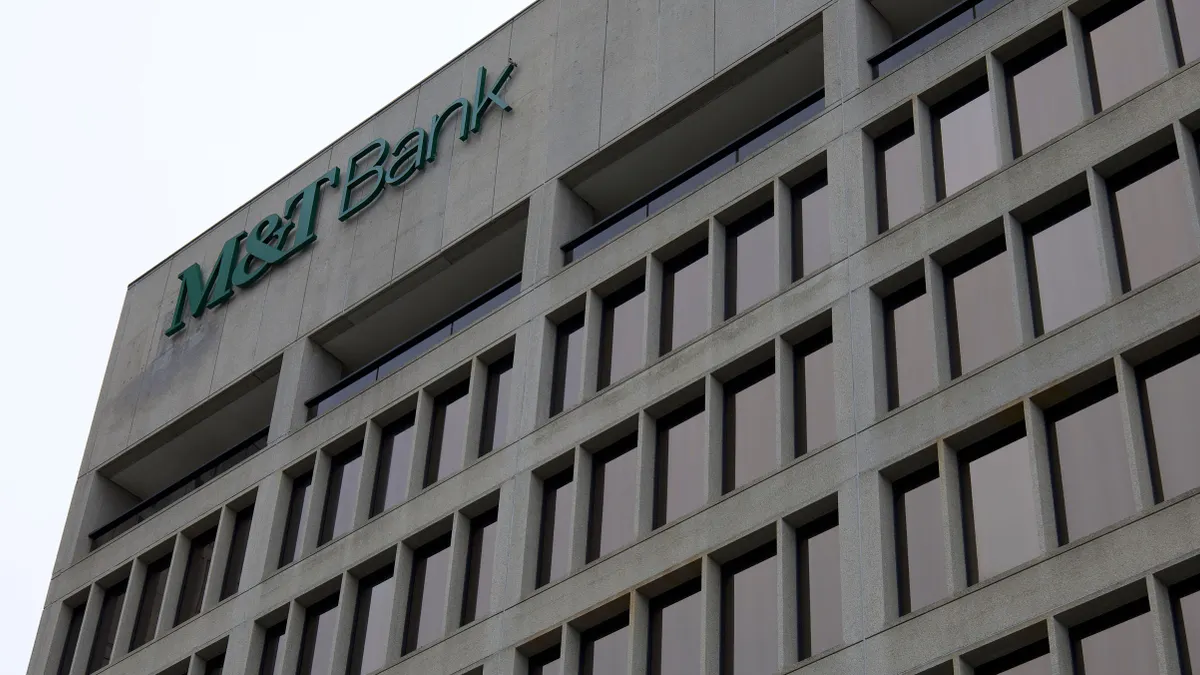
M&T Bank is talking to potential acquisition targets, but the lender isn’t rushing to strike a deal, CFO Daryl Bible said Tuesday.
Barclays analyst Jason Goldberg asked Bible why the $213.8 billion-asset bank has been “noticeably quiet” on M&A despite a more favorable regulatory attitude toward deals.
Bank executives have been peppered with M&A questions, since the probability of regulatory approval has increased materially. Meanwhile, the average time to secure approval has dropped, and many banks crave greater scale.
“We have a specific number of candidates that we're talking to,” Bible said at a Barclays conference Tuesday. “At some point, maybe one of those might want to sell and do it at a reasonable price that makes sense for both sets of shareholders in the long term.”
“We're very patient,” Bible said. “It will happen when it happens.”
All of the candidates are within M&T’s existing 13-state footprint, Bible said, adding that’s an area where the bank differs from other lenders who’ve sought to enter new states or territories.
“We are not chasing growth. We want to get more scale and density in the markets we serve. We think that's a better way for us to serve our customers and our communities,” Bible said. “We think it's a good long-term strategy, both from a profitability perspective and from knowing your customers, your clients from a credit perspective.”
Over time, M&T may “inch out a little bit,” Bible said. But for the most part, the bank plans to keep its focus on the Northeast and Mid-Atlantic areas.
M&T CEO René Jones made similar comments last November, making it clear the lender is uninterested in pursuing national scale. Fellow regionals Fifth Third and Huntington, both based in Ohio, have expanded across the Southeast and Texas. Jones seemed to cast doubt on banks’ ability to execute at the same level as their footprint expands.
“As you get further and further away from home and [add] more geographies, I think the management challenge goes up,” the CEO said last year.
M&T last acquired Bridgeport, Connecticut-based People’s United for $7.6 billion, in 2022. The regional bank encountered hiccups with its conversion of People’s United, which drew regulatory scrutiny.
Some analysts expressed surprise that M&T wasn’t the acquirer of Stamford, Connecticut-based Webster Bank, which Spanish lender Banco Santander said in February it would buy for $12.3 billion.
Webster, with $84 billion in assets, “appeared to check the boxes” for deals M&T would be interested in, Jefferies analyst David Chiaverini said in February.
The Santander acquisition presents opportunity for M&T, Bible indicated Tuesday.
When banks merge within M&T’s footprint, “we basically want to take advantage of if there's any things that happen in the integration periods or people don't like the change of how things are done,” he said, with the goal of poaching employees or customers.
Bible seemed to downplay the idea of M&T making a nonbank acquisition, mentioning the difficulty of a regulated financial institution absorbing an unregulated company.
“A lot of those don't really end up performing really well long term,” he said, adding it’s “important to bring people into the company that know expectations, know how things work and all that, rather than try to educate them, going from a non-regulatory environment to a heavily regulatory environment.”
Piper Sandler analyst Scott Siefers expects M&T to remain disciplined with M&A, but noted dynamics such as momentum around the bank’s net interest income this year could increase speculation “that a deal becomes more likely as a means to address growth questions,” he said in an April 15 note.
U.S. bank M&A activity in the first quarter slowed from late 2025 levels, according to S&P Global Market Intelligence. About 35 deals were announced through March 31, which almost matched the 36 deals announced in the first quarter of 2025.
The Santander-Webster deal represented nearly 80% of the first quarter’s $15.64 billion deal value, the firm said.