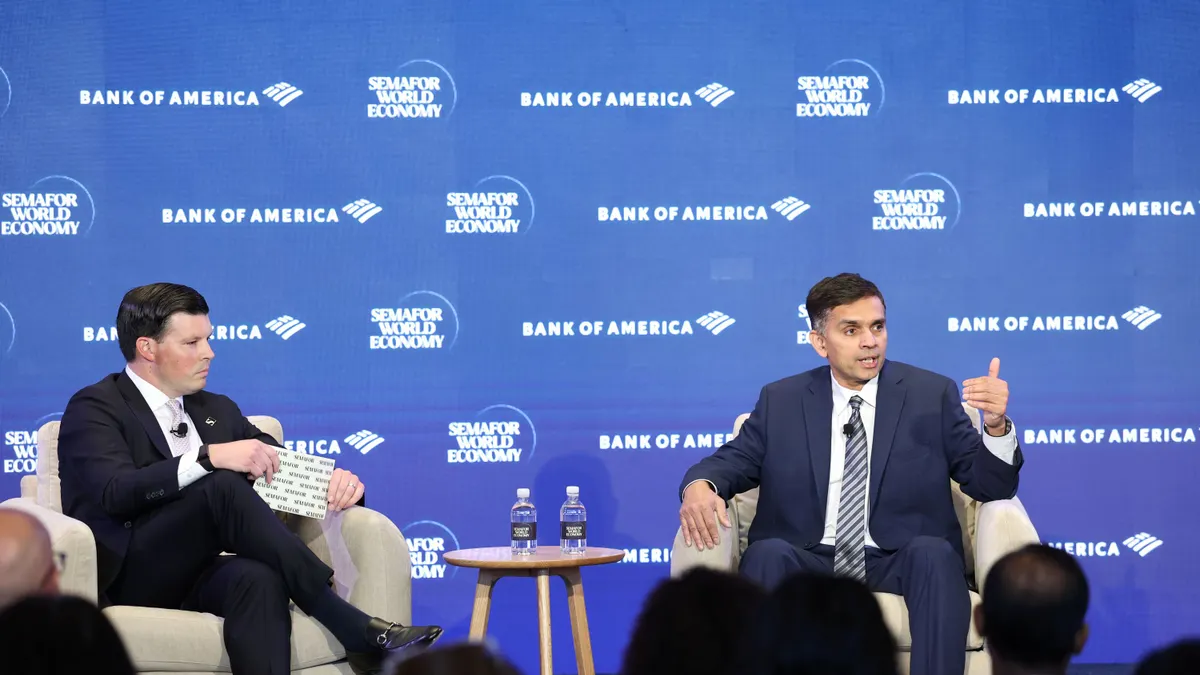
Standard Chartered CEO Bill Winters apologized Friday for his characterization of back-office roles as “lower-value human capital.”
StanChart, at an investor event Tuesday in Hong Kong, announced plans to eliminate more than 7,800 “corporate functions” jobs over the next four years in favor of artificial intelligence. But Winters’ choice of words spurred blistering criticism.
“It’s not cost cutting,” Winters said Tuesday. “It’s replacing, in some cases, lower-value human capital with the financial capital and the investment capital we’re putting in.”
Winters acknowledged Friday in a LinkedIn post that his remarks “caused upset to some colleagues.”
“For that I am sorry,” he wrote.
Winters also sought to clarify his comments by including a transcript for context.
“I think the transcript makes it clear that I value our colleagues – all of them – most highly and that we are totally committed to helping them to cope with the accelerating pace of change in our industry,” he wrote.
It’s the latest in a series of clarifications Winters has sought to make. In an earlier LinkedIn post Friday, the CEO said StanChart, for years, has “invested actively in helping colleagues whose roles may be displaced by automation to build the skills needed for new opportunities within our organization.”
“In that context, I said that lower-value roles are more vulnerable to automation, and that we have a responsibility to help colleagues move into higher-value roles,” Winters wrote Friday. “We will continue to speak honestly about the impact of technological change.”
Some commenters were unconvinced.
“‘Taken out of context’ is the oldest deflection in the book,” one commenter wrote. “If you're cutting 15% of your workforce, the ‘building skills for new opportunities’ line doesn't land – it insults people's intelligence.”
After some initial brushback, Winters first sought to reframe the narrative Wednesday in a memo to employees, seen by Banking Dive.
"I want to be absolutely clear that the future of Standard Chartered depends on the talent, judgment, relationships and commitment of you, our colleagues," Winters wrote in Wednesday’s memo. "Our progress and ambition are only possible because of what we achieve together.
“Where roles do fall away, it reflects changes in the work, not the value of our people,” he added.
Fellow bank CEOs had their own take on Winters’ Tuesday comments. JPMorgan Chase CEO Jamie Dimon, who described Winters as a friend, called the StanChart chief’s wording “inartful.”
“I think it will be old jobs,” Dimon told Bloomberg on Thursday, categorizing the work replaced by AI. “If back-office jobs disappear, we need more front-office jobs to cover more clients.”
Dimon projected that AI would reduce the workforce at his bank, too, “down the road,” but said “it’s incumbent upon us, society, to think through if it happens too fast.”
Barclays CEO C.S. Venkatakrishnan, speaking to Bloomberg on Wednesday, emphasized the importance of human capital.
“What people do are jobs, and a job is much more than a collection of tasks,” he said. “And that’s the thing we have to keep in mind, I think.”
He added that he has seen an increase in personal productivity from using AI, “just as when search came on the internet.”
“Now you’ve just got to take tasks and make them more productive,” Venkatakrishnan said.
Barclays wasn’t the only London-based bank to touch on that. HSBC CEO Georges Elhedery told his bank’s workforce to make sure they were "not fighting us, not disenfranchised, not anxious, overwhelmed, and resisting the change," adding that AI could make them "more productive versions of themselves".
"We all know generative AI will destroy certain jobs and will create new jobs," Elhedery said, according to Reuters.
For his part, Winters, in his Wednesday memo, reinforced the same.
"Some roles will reduce in number, some will change, and new opportunities will emerge. We will continue to prioritize investment in reskilling and redeployment wherever we can," he said. “Where changes do happen, we will handle them with thought and care.”
But again, LinkedIn commenters largely blasted Winters’ sentiment.
“People should not be framed as disposable inputs to be replaced by financial capital or AI,” Simon Peter Leung, a Singapore-based risk and compliance executive, wrote Thursday on LinkedIn, in response to a Tuesday post from Winters.
“Calling staff ‘lower-value’ is not only insensitive, but also risks undermining trust and morale,” Leung wrote. “This is how the bank gets a bad name in the job market.”
Leung, who has worked for BMO and BNP Paribas, may not be an objective voice. He’s also a StanChart alum, according to his LinkedIn profile.
At least one regulator, the Hong Kong Monetary Authority, asked StanChart if Winters’ comments were meant as a pretext to use AI to cut staff, Bloomberg reported Thursday, citing a person familiar with the matter.
“Talent is core to our strategy as we continue to invest to create new, reskill and redeploy roles,” StanChart said in an emailed statement. “This will be done in line with regulatory expectations.”
Stiff pushback came from at least one former head of state, too.
Singapore’s former president, Halimah Yacob, in a Facebook post Tuesday, called Winters’ comments “disturbing” and “demeaning,” and asked StanChart to “carry out retrenchments humanely” and “treat workers with respect.”
StanChart generates most of its revenue from Asia.