LAS VEGAS – BitGo has had a big 18 months. The digital asset infrastructure and crypto custody company was granted an unconditional national trust charter in December, five months after applying to convert from a South Dakota state charter.
Then, in January, the company went public, debuting on the New York Stock Exchange with a $2.59 billion valuation.
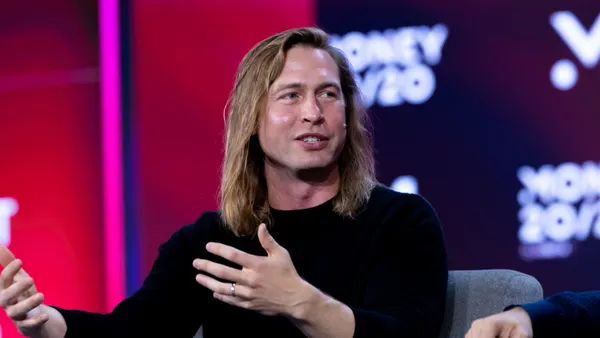
Perhaps unsurprisingly, the pair of developments “gave us some strong tailwinds,” Frank Wang, BitGo’s managing director and head of North America fintech sales, said in an interview at the Money20/20 conference in Las Vegas.
Interest from financial institutions has been “noticeably stronger” and “steadily increasing” ever since, Wang said – including two requests for proposals from large financial institutions Tuesday alone.
“The reason that helps is as we are looking to enable highly conservative, regulated financial institutions to touch digital assets,” Wang said. “For a lot of these banks, they're super conservative, super bureaucratic – and for anything to get done, you have to satisfy risk compliance.”
Many of the banks’ internal stakeholders, he said, are newer to crypto but interested in exploring stablecoins and tokenized deposits so as not to be “left behind” by peer banks. But building the infrastructure to hold up these products is expensive, he said.
BitGo offers banks two options: a bank can either use BitGo’s software to manage digital-asset wallets and custody the assets itself; or a bank can have BitGo Bank & Trust custody digital assets. The latter option, Wang said, offers a regulated intermediary for banks that prefer not to handle custody themselves.
It’s “an easy button for you – a community bank or midsize bank or regional bank – to touch digital assets,” Wang said.
Several banks are launching, or have launched, their own stablecoins this year. U.S. Bank debuted its USBDC in September. Wells, Bank of America, Citi and 18 others are partnering on the creation of one set to go to market next year. SoFi launched SoFiUSD in December, making it the first stateside bank to do so.
Federal regulators just gave the digital currency a likely boost: This week, the Office of the Comptroller of the Currency issued its final rule to implement the Genius Act, which created a regulatory framework for stablecoins.
The rule will take effect Jan. 18, roughly 18 months after Genius was signed into law.
When digital assets and the blockchain technology underneath them gained steam several years ago, “there was this narrative that … digital assets and blockchain would displace traditional financial services and disrupt things and replace banks,” Wang said.
Now, it’s clear that that isn’t going to happen, he said.
“You have this massive trillion-dollar industry of financial services and banks, and those guys aren't going away,” he said. “They are just going to become better banks by using blockchain.”
A number of digital asset-focused companies have applied for national trust charters like BitGo between this year and last, and at least 21 have been conditionally approved. Fewer have been unconditionally approved, like BitGo.
Being nationally chartered “functionally has enabled us to do more things in more states,” Wang said, as the national trust charter preempts state-by-state money transmitter licenses that it previously needed. MTLs “can be expensive to obtain and maintain,” he said, “so that has been a likely cost savings for us.”
BitGo continues to pursue licensing internationally, as well. It has regulated entities in Germany and Singapore, and a joint venture with Hana Bank in South Korea.
With the boost from gaining its charter and going public stateside, the bank has increased manpower in response, as well as its use of AI.
“At the end of the day, though, a human still has to look at every response,” Wang said. “AI can help, but should never be a crutch … But it's getting better, so it is a force multiplier for us across the organization, both on the technology side as well as process.”
BitGo engineers are putting out code three times as fast as they used to, he said.