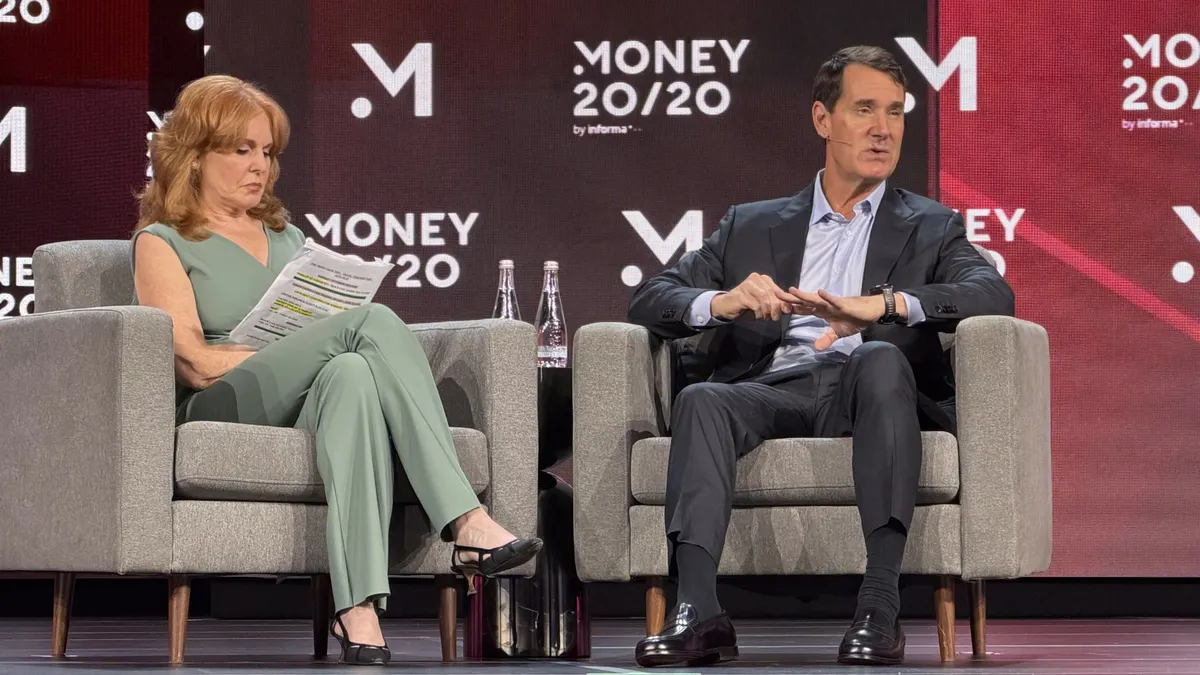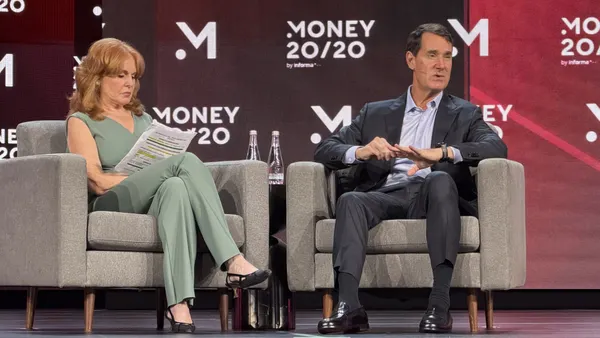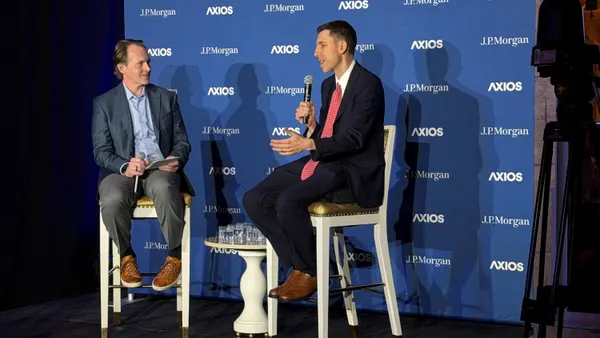
LAS VEGAS – As artificial intelligence reshapes the industry, Plaid co-founder and CEO Zach Perret expects financial services will become “a monetization lever” for AI platforms such as OpenAI’s ChatGPT and Anthropic’s Claude.
Perret, speaking Tuesday at the Money20/20 conference in Las Vegas, pointed to card issuance as an example, in which those companies would collect interchange fees from the card issued and embedded within the AI platforms, which he referred to as “harnesses.”
“That's a pretty straightforward thing to have happen,” Perret said. “Maybe they do more lending products and so forth, but I think the card issuing will make a lot of sense in step one.”
San Francisco-based Plaid, one of the largest financial data aggregators, works with about 12,000 institutions, connecting customers’ financial accounts to other apps and services.
As AI platforms go from analysis to action, Perret said he’s watching to see which financial services functions continue to be conducted through a bank’s platform and which occur through AI platforms.
“Is the entirety of your financial life going to live within the harness,” he said, “or are you going to see the banks themselves, or the fintechs themselves, start to launch agentic experiences that live right there?”
The impact of AI agents on the industry and their role acting on customers’ behalf was one of the biggest topics of discussion at Money20/20, spurred by big-bank CEO commentary around liability and risk, as well as buzz around personal AI agents such as Meta’s Muse.
AI-related business disruption poses moderate risk to banks over the next five years, “mainly through increased technological competition on processes and products,” Fitch Ratings said Thursday.
Most exposed would be banks catering to households and small and midsize businesses, “whose financial products are mostly standardized, high volume, and easily replicable,” Fitch said. “However, the impact would depend on how quickly customers adapted their preference for new, AI-led service models.”
Fifth Third CEO Tim Spence on Monday said he expects bank incumbents will respond by building services into their apps that consumers can handle through Muse, offering “bank-grade information security,” among other things.
Perret said a neobank issuing mortgages, for example, might see banking queries within AI platforms and want to build their own version that has richer information and is well-tailored for specific users.
“I would want the mortgage conversation actually to happen in my four walls, as opposed to outside,” he said.
He predicted the industry will see “another set of agents coming from basically every financial application.”
Fintech chatbots from around 2020 “all sucked, so they disappeared,” he said. “But there's going to be another wave of chatbots.”
Because there’s a range of interaction levels and customer preferences, it’s unlikely any one entity will own the entire customer relationship, Perret said.
“If you want to chat with your finances, why aren't you able to do that within your bank experience? That seems like a great thing. Why aren't you able to bring in external data into that given bank experience?” he said. “I suspect that we'll see more and more of that.”
Over time, customers may want the ability to handle certain bank functions through AI platforms, such as rebalancing between checking and savings accounts, where getting a mortgage may be something they want to interact directly with the bank for, Perret said.
It would be “crazy” to say no financial functions will be available through AI platforms, “but it's also crazy for me to say that everything will be through the harnesses, and that's a concern,” Perret said.
The CEO also said he thinks a Deloitte projection that generative AI could push U.S. fraud losses to $40 billion by next year is “a conservative estimate.”
“That's probably not including the risk of agent swarms attacking banks, which is even more terrifying to me, frankly, than AI-enabled fraud or deepfakes or things like that,” Perret said.
Plaid’s leadership team routinely discusses the frontiers of security and fraud in financial services, “and if I'm honest, I'm quite scared,” Perret said.
“We are rapidly doing everything we can from a security perspective, from a fraud perspective for our customers: talking about security, giving them tools, giving them recommendations,” he said. “But I think that we're going to have a scary year, from a security perspective.”
“We're just in a dead sprint using AI to fight AI fraud,” Perret said.
The company is building products that tap a network of data unique to Plaid, he said, but it also partners with a number of companies to build better fraud prevention tools for customers. “Fraud is a collaborative game,” he said.
Still, “as an industry, I think this is a huge problem that we're going to be dealing with for a few years.”
“If people have suggestions or ideas, I'm all ears,” Perret said. “We're doing what we can, and I hope that as an industry, we can come together and do more.”