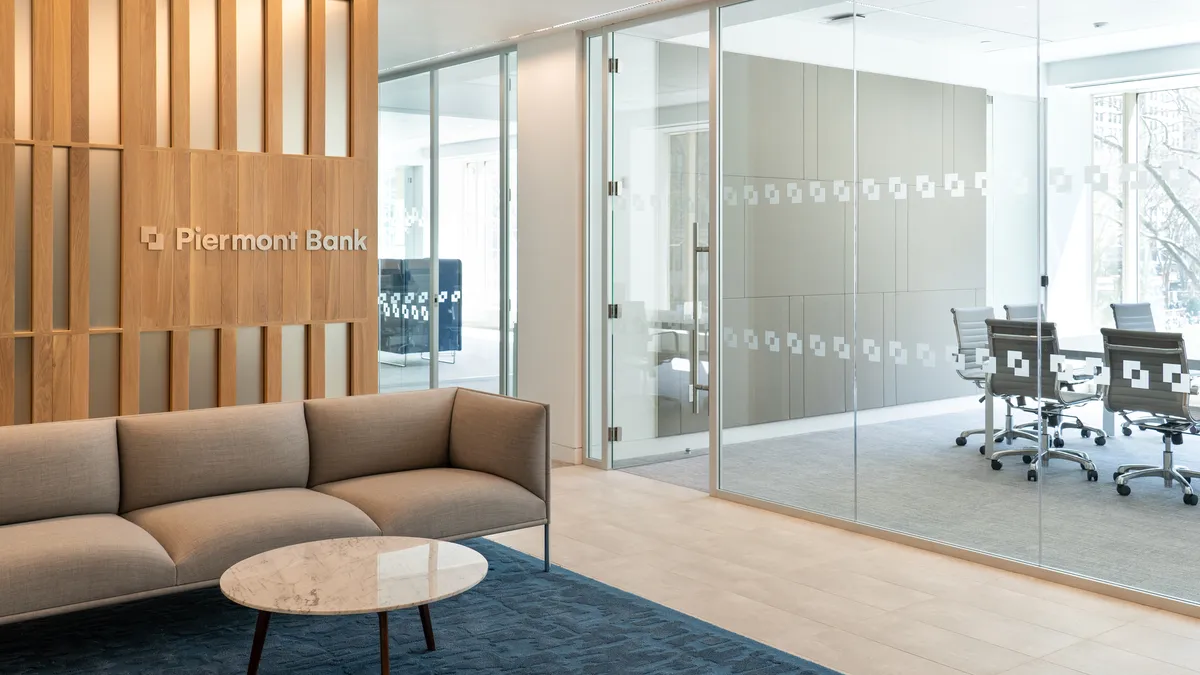
Fintechs’ and nonbanks’ pursuit of charters may change the landscape, but the CEO of Piermont Bank is watching to see how newly chartered entities handle their regulatory responsibilities.
“It's one thing to get a charter,” Wendy Cai-Lee, founder and chief executive of the New York-based digital commercial lender, said in an interview last week at the Money20/20 conference in Las Vegas. “It's a whole other thing to be able to get a good CAMELS rating from your annual safety and soundness exam.”
Cai-Lee was referring to the ratings system that assesses a bank’s capital, asset quality, management, earnings, liquidity and sensitivity to market risk.
As regulators have signaled openness to novel charters, fintechs and other nonbank firms have pursued national bank charters, trust charters and industrial loan company charters, which is poised to reshape the bank partner business.

Within the federal banking agencies, staff approving charter applications are completely separate groups from those in risk management, and “they look at banks from very different angles,” Cai-Lee said.
“How well you execute against your plan, that's when the examiners come in,” she said. For many of these newly chartered companies, “time will tell.”
Over the next year or two, Cai-Lee is tracking “how well they do, and what type of role they will play and what type of impact they will” have.
The CEO said she tells her team that marketplace noise is ever-present. “If it's not this, it's something else,” she said. “And I said, ‘This is outside of our control, so let's not get distracted by that.’”
The $505 million-asset lender continues to build toward becoming a “full, omnichannel, embedded banking provider,” Cai-Lee said. That includes “for benefit of” accounts, card issuance and embedded lending.
Piermont, founded in 2019, reported a $5 million loss for the first half of this year. That followed a $4.6 million loss in 2025 and a $5.3 million loss in 2024, according to Federal Deposit Insurance Corp. data.
In 2024, Piermont entered into a consent order with the FDIC over alleged banking-as-a-service deficiencies. The lender never considered exiting BaaS as the business segment faced more scrutiny, Cai-Lee said. She said it’s essential to understand regulators’ concerns and work to bridge gaps with them.
Last week, the bank announced two fintech partnerships, one with BlxckPay and another with MassPay. In the former deal, Piermont is linking employer business bank accounts with employee payroll cards, including for seasonal agricultural workforces. For the latter, the bank is pairing payment rails and settlement services with global payout capabilities for burgeoning businesses.
The bank declined to share how many clients it has or who some are. While Piermont seeks to grow its client base, expanding the work it does with existing customers is more the focus, Cai-Lee said. “We always want to deepen,” she said, “than go really broad.”
“The more we know about a client, the more that we bank within that particular sector, industry, it allows us to risk-manage much, much more efficiently,” she said. Spread across different types of niche sectors carries “industry risk overlay that people tend to not pay attention to.”
Piermont was a partner bank to Parker, a fintech that filed for bankruptcy this year, handling its banking product. Stamford, Connecticut-based Patriot Bank was the fintech’s other bank partner, for its commercial credit card product.
Piermont wasn’t “comfortable” with some of Parker’s business, but handled the FBO, Cai-Lee said.
“We didn't lose a single penny because we figured out which part of their business that we didn't want to do,” she said. “That's how [Parker] went to other banks.”
When a fintech fails, Piermont employees do a deep dive on potential lessons learned, even if the fintech doesn’t work with the bank, she said.
Piermont’s fintech clients are assessed no differently from large loan customers, Cai-Lee said. “You’ve got to make sure your due diligence, your onboarding, your ongoing monitoring, is as disciplined as you're comfortable with,” she said.
That means that the partnership is regulatory-compliant and within the bank’s risk appetite. And once the terms are set, the bank has to hold the line.
In embedded banking, when a fintech breaches their reserve and needs to top up but cannot, staying disciplined is key, Cai-Lee said but acknowledged it’s not easy.
“If you have a very large client, supposedly very well-funded, they said, ‘Hey, you know what? Yeah, we forgot. We'll top it up.’ And a week goes by, two weeks goes by. What do you do? Do you actually shut them down?” Cai-Lee said. “For us, contractually, the bank reserves the right to pause. But can you really pause your client? That's tough.”
The CEO indicated she’s also watching to see how artificial intelligence reshapes banks’ reliance on fintechs for certain services. As banks tap artificial intelligence in the march toward greater automation and efficiency, it’s likely to impact some fintechs’ value, she said.
“With AI, does the bank still need some of what the fintechs bring to the table?” Cai-Lee said. “Fintechs need to think about how … they go up the value chain, so to speak, so that there's real value proposition to be a partner for a bank.”